![[personal profile]](https://www.dreamwidth.org/img/silk/identity/user.png) glenatron
glenatronTom and Sarah Widdicombe are horse trainers and clincians who have worked with a lot of horses, developing a simple and very reliable approach based on keeping things clear and easily understandable for the horse. Tom is the author of the quite brilliant Be With Your Horse while Sarah wrote The BHS Book Of The Natural Horse which I shall be reviewing shortly. I got a lot from spectating at one of their clinics last year so I was really happy to have a place on this one.
This was a four day clinic with most horse and rider pairs getting two sessions per day, one longer exclusive one in the morning and then having two pairs working at opposite ends of the (sizeable) school in the afternoon, one with Sarah, the other with Tom. We had an interesting mix of baby horses, older more seen-it-all ponies, Zorro and I somewhere in the middle and one very troubled horse, who was only around for the last two days.

To keep things flowing and easy to follow, I will talk about this clinic horse by horse, which will hopefully make it easier to see how everyone progressed over the four days. I'm sorry to say that my camera went flat about half way through so there are fewer pictures from the last couple of days although the ones I have are slightly better cos I borrowed our friend's very classy SLR and stuck my SD card in it. Also, I've tended to choose pictures that I liked as pictures so they're not always terribly informative and don't necessarily follow what I'm talking about...
The themes of the clinic were very much on solid basics, finding softness by working through braces and on helping horses to feel secure by making it easy to understand what you are asking for.
Brian ( right up there with "Attack Baby" on my list of favourite horse names ) is a four year old fresian- bought from an importer as a recently backed riding horse. Trevor, much like me a couple of years ago, was introduced to horses by his girlfriend Janet ( who brought little Seamus to the previous clinic ) and has totally fallen for them. They were of the opinion that Brian is not nearly as comfortable being ridden as the dealer had suggested and after some anxious moments on his part had decided it was probably worth restarting him altogether.

Brian and Tom.
Tom started by getting Trevor to really guard his personal space, working on leading, stopping and backing Brian away. Also asking Brian to just stay still, so he can understand he doesn't have to be moving his feet the whole time and that he doesn't need to be pushing on Trevor's space. By looking for the thought about moving and keeping the horse's attention it's very easy to set things up so they can keep their focus on you and you can keep them in the right place without having to put in too much energy and risk making them agitated. Standing still at the end of the line is still a job that the horse should be able to do.
On the leading Brian was inclined to rush off, Tom observed that if your horse won't lead with you at your own speed then he's not really ready to ride. When the horse gives you something you don't want you need to correct it. With Brian it was clear that Trevor ( yes, those are both classic bloke's names and Tom did indeed keep getting them muddled up all weekend ) needed to be really enforcing those boundaries. As he started to do so Brian started to relax and drop his head.
They moved on to working on a circle, Tom asking initially for a simple walk on the line and stopping when he was asked. Brian tended to want to run off, Tom just wanted him to offer a nice relaxed walk- he commented that if you do the simple things right there is nothing difficult about horsemanship. This was very much a theme of the weekend- get the basics really solid and everything else will fall into place.

Brian on the lunge.
When Brian was tending to rush off ahead, Tom had Trevor just step towards his hindquarters a little to bring Brian's attention back as Trevor started leaving his field of view, which would also push him a little more round onto the circle. With Brian it was largely a case of ignoring his anxious moments when he felt like running off and just waiting for the good stuff to come along then really rewarding it by giving Brian a break after a bit of good walking and so on. All the horse really wants is an easy life and by making it easy for them to understand what we want we offer that.

Trevor leading Brian before they move on to long-lining.
Their second session began by working on the backup, trying to find softness and to make being with us the place that the horse can feel soft. Most horses will tend to brace a bit when asked to back up - it's important not to release while the horse is braced if you want them to learn to be soft. Once you've found something the horse braces against you need to find a way to release that brace before you release the pressure on the horse or they will just learn that braces work.
They went on to working on the long-lines. Brian found this a bit anxious at first but Tom just kept him turning and offering a consistent ask until Brian was able to offer him a steady walk. The long lines work well for helping a horse prepare for ridden work because we can ask for the same things that we want in the saddle.

Long lines were a little concerning at first...

But he soon settled.
They continued working on the long-lines in his third session. Tom was discussion how we can tend to give horses, especially horses who have had problems in the past, too much freedom, more than they know how to handle. They need to know there are limits and that we are in charge. Most horses find that very easy to accept.

Sarah talks them through some long-lining.
Brian was very keen to overbend- it looked like he had been worked in some kind of gadget to draw his head in and kept looking for release there. The solution to this was just to keep working and asking for a few steps and a halt with a natural head carriage. Keep working until it's right- he's smart enough to work out that putting his chin on his chest isn't working any more, but he'll need consistent work to really understand it.

Overbending.

Working nicely on the last day.
In their final session, after some very dramatic trotting on the long lines and much less overbending thanks to a mix of latent learning and an extra early morning long-lining session Brian was working really nicely. At the end of the session Trevor got back on him. Brian seemed quite content with the arrangement.

He can really trot.

A big moment for Brian and Trevor.
Because of some other personal commitments Trevor wasn't able to work on all the sessions in the clinic so he shared with Janet, who was playing with little Seamus. I don't have lot of notes from these sessions because they were quite late in the day, but I do have some pictures:

Seamus on the long lines.
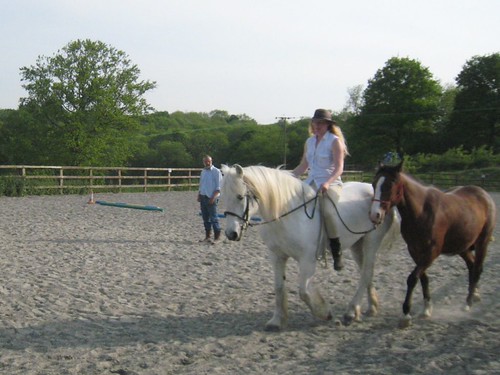
Janet ponying Seamus off her older mare.

Ponying through an obstacle course.

Jester and Tom.
Jester is a little black pony who has seen and done a lot of things in his life (pony club, jumping, general kids pony type life) and settled into a lowest-common-denominator life of doing the least effort he could get away with. He had been lucky enough to end up with Michaela who initially gave him some serious horsey time out in the field and then has brought him back into Endurance work, which he does a pretty good job of but he was still showing a lot of those traits of the older horse who has got a little shut down over the years.
They began by establishing personal space again. I noticed that any time Jester started to push on Tom's space he would get pushed back further than he moved to start with, so one step towards Tom would get pushed back several steps. It's a very simple system but absolutely effective.
Tom talked about wanting a push-button horse, how in the past he realised that he was riding wild horses and that it simply wasn't safe. One of the main themes of the weekend was the idea that you need your horse to be willing to allow you to direct them at all times. If you don't have that then you're sitting on a horse that has a certain amount of wild animal right in there. That's absolutely your right, but there's no point complaining if the wild side reveals itself at the most inopportune moment.
Once again the starting point was to set up a simple understandable job that Jester could understand and do. That would give him a reason to feel good about the work they were doing. The communication was all about simple pressure and release- you show the horse what you want and you put a little more pressure on when they're doing something else and release it as they get closer to what you are asking for.
Another repeating theme, and a phrase we heard a lot over the weekend, was "make it happen" - being an old hippy Tom really felt he should appologise for using the term, but it's a very useful way of thinking. Once you have decided your horse is going to do something you really need to make sure they do that thing. Most of us really needed to work on getting commitment into everything we asked of our horses. Because she lacked a bit of commitment when asking for her personal space Jester had effectively trained Michaela to back up.
On the lunge Jester was doing a lot of things more or less as distractions from the job in hand, dropping his head to the floor, bending to the outside anything but pay attention to the person in the middle of the circle. This is quite a common outcome of traditional lungeing which is usually done with an eye to the horse's phyical fitness rather than their mental fitness so the horse is just pushed around in circles indefinitely. Tom got Michaela working to get his attention back, making a noise, slapping the tail of the rope against her leg, stepping back towards his hind quarters and his blind spot, meaning he needs to turn in a little to be able to see her, really working to get him thinking about what he was doing and what she was asking. By looking for the first signs that he was thinking of taking his attention away and asking for it then it should be easier to bring it back.
While they worked on this Tom talked a lot about getting the horse with you, working voluntarily, not just doing what they are told because you are making them do it. At first you have to look for small tries - especially the horse giving up on their idea and taking on yours - and give them big rewards.
The next day they were working further on keeping his attention. They switched over to the rope halter as something he couldn't lean on as easily as his regular webbing one and had Michaela trying to be like a post- she doesn't pull on the rope if he starts to lean on it, she just doesn't yield so the horse runs into his own pressure. And when he comes back off it he releases himself. It's all about pressure and release.

Jester happy to charge about and not pay much attention...

...Tom just ignores the drama and asks him to get on with it.

Another hectic pony moment.
They worked on the lunge, doing quite a bit of canter as Jester has a stiff hip- he's had a lot of treatment for it and he gets through the endurance vet checks fine but he be a little unsound until he's warmed up. As he freed up his body his mind seemed to free up a little too. Tom commented that sometimes with horses there can be very little distinction between a mental or physical block.
Once he was warmed up, Michaela got on and they started doing some ridden work. Like most horses who haven't been explicitly taught about the bit Jester was pulling through his halts- his feet would stop but he would keep leaning on the bit. The starting point for all of the bit work we were doing over the weekend was keeping the pressure there until the horse softens. The essential part of Pressure and Release is that the point of release is when you tell the horse they are getting things right. If you release while the horse is braced then you're teaching the horse to brace. Most people have done that.
The bit is really important- it's a fantastic way of finding softness in a horse once they understand it, but while they don't understand it they can use it as a distraction from what you are asking them to do. If the horse leans on the bit in the halt it indicates they are still going forward mentally even if they have stopped their feet moving.
Teaching understanding of the bit is the first step to more advanced work- you need softness from the front to the back of the horse before you can get the horse working from the back to the front. A correctly used bit is a great way of finding softness in your horse and once they understand how it works and that you will use it in a logical and consistent way it can be very reassuring for them as well.
The starting point is not releasing on a brace, waiting for the horse to soften when you halt before you release. You don't pull on the rein, you just make your hands like a post so that the horse runs into their own pressure and then finds their own release- it's not a relative post either, it's as though you had put the reins over a post at your halt point- the more the horse goes forward the more they run into it. Jester was tending to lift his head up and fling it around when any pressure came on the bit, which is one classic reaction to a horse that doesn't really understand it. At first it was a case of waiting for him to stop pulling and give him the rein when he softened a little.
It's very easy to overdo this type of work - you need to be careful not to teach the horse to put their head on their chest as that is very difficult to undo.
On Saturday they began by revising the ground work- Michaela was being much more definite and precise but Jester kept coming trying things again, which suggested that she wasn't necessarily doing enough to change the behaviour. They worked on making it clear that he has crossed a boundary and really responding accordingly- as a guideline, if the horse hasn't moved their feet you probably need to be doing more if you're correcting something like invading your personal space, diving on grass during work time and so on.
When you have a horse with niggles they will sort out over time if you can present solid consistent horsemanship and you don't add to the confusion. Confusion is one of the main causes of problems that horses have.
In the saddle they worked on getting smoother transitions as Jester was tending to slightly throw himself into them- Tom talked about how if a horse overreacts on the transition it is probably because he feels he is being over-asked. They got some really good results, but Michaela was tending to ask for a little more than Jester could offer at that point - Tom's philosophy is that if you are doing a lot better in general now than you were previously then you should leave it at that rather than getting overly caught up in trying to correct every detail. Once the general picture is consistently right you can start building the details in bit by bit. If you try and do it all at once you're setting yourself and the horse up to fail. I guess it's a bit like if you had a staircase and you decided to pile all the steps on top of each other instead of leaving them stepped. At that point you've just got a wall and it's a whole lot harder to get up to the bathroom.

Jester and Michaela on the rampage.
Tom talks about doing the work and then letting it rest - "bank it" is a phrase he used a lot - and trying again tomorrow. Usually horses will be better after having had some time to think over what they have just done.
On the Sunday they were really working to get Jester to stop Zoning Michaela out- he was still really ignoring her on the lunge, working with a big brace to the outside - the classic shoulder-in-banana shape of a horse that has done a lot of lunging without having learned to lunge correctly.
Sarah spent a while with him on the lunge, really pushing him to pay attention- a lot of high energy stuff and quite a few protests from Jester, which were roundly ignored. With all the horses Tom and Sarah's reaction to something they hadn't asked for, especially the more explosive stuff, was essentially "that's nice, now why not get on with the job I'm asking you for?" The unwanted behaviour was basically ignored or a little more pressure was applied while it was going on until the horse could really understand what the job it was being asked for was and that it could do the job without making a fuss.

Jester is moving but he's not really paying Sarah any attention.

Still not a lot of attention.
They did some other work on keeping the horse's attention, working to stand with him and do something to bring his attention back any time it started to wander. After a little bit of work with this Sarah had him staying right with her on a loose rope, going exactly where she went and following her movement very precisely.
Leia is a three-year-old Section D filly, who had never really been anywhere before. She was anxious, not only because of the new situation but because her whole disposition was strongly oriented towards the tremulous. This clinic was to be her first experience of work and the start of her backing process.
The immediate starting point was to find something simple to ask for and to keep asking until you got it. If the horse is on the other end of the line throwing themself around then that is fine, just keep the ask there and wait for something practical to come of it. From the very start Tom reccommended developing a good work ethic in the horse- if you instill a sloppy work ethic you'll only have to fix it later. For a young horse these first sessions are very important.
Leia was very flighty indeed so having got a bit of focussed work on the line Tom moved on to some sacking out, first holding the rope against her until she stopped trying to move away from it and the swinging it gently onto her. All of this is essential for developing a solid riding horse that doesn't run away from the saddle or react in unexpected ways if the rider bumps into them while mounting.

Starting on sacking out with a soft rope.
With the sacking out the important thing is to stop as soon as the horse makes the commitment to stop running away. Especially with a flighty horse like Leia she needs to know that running away is not the solution to the problem. Tom was keeping the sacking out going until she not only stopped moving but stopped quivering when the rope touched her- at that point she was clearly a little more able to cope with it. They went through the same exercises with a dishcloth and a plastic bag until Leia was able to accept all of them being touched all over her.
They moved onto the classic yielding exercise where you ask the horse to follow a feel from a rope around it's body. This is useful in various ways- as Tom teaches it you loop the rope over the horse's head and then move it along it's back step by step (hence this needing to be done after the sacking out ) until it is around their hind legs. Then by offering a gentle feel on the rope you ask the horse to turn around in a complete circle and come in to you. As well as helping them yield and follow a feel, this is a great exercise to prepare a horse for accepting long lines.
This is one part I actually did get to illustrate properly:
Because Leia is so young they did various things for short times- anything done for too long is likely to lose a young horse's attention and too much work on the circle can damage young joints.

Getting a bit anxious on the circle.
During their second session they did some similar work, starting on the circle and making sure that Sarah was able to bring Leia's attention back as it started wandering, rather than letting it get any further than that. By matching her feet to the horse's movement she could use her own paces to cue up the horse and get them both moving together so that when Leia was on a 10 metre circle Sarah was on a 7 meter circle inside it. Leia was making Sarah work quite hard to keep her attention, Tom recommended doing whatever was necessary to get it- making a noise or a sudden movement or generally doing something unexpected to make the horse feel it was worth paying attention back to her. He observed that with anything in horsemanship if you're having to do the same thing again and again then it's not working- this is the problem with the "kick-kick-kick" school of riding. When she started phasing Tom out he was slapping his leg with the rope, clicking her on or stamping his foot and kicking up a bit of sand to get her back to him.
They did a lot more sacking out using a rope and a flag (improvised from an old Parelli stick - the yard where the clinic was held is the old home of Parelli UK and they find all kinds of bits and bobs from the old owners ) to help her be a little braver. Tom explained how with really reactive horses if you don't do a lot of this type of work you end up with a horse you are perpetually having to go softly-softly around. He recommended using as many things as you can think of to desensitise the horse- don't take risks but on no account mollycoddle the horse. Much better to have half an hour of intense work and let the horse get through it than to have months of low-intensity work which is likely to be more stressful for them in the long term.

Sacking out with a flag- Leia is moving away here...

...slowing down and thinking about what is going on a bit more...

...until finally she can stand still and accept it.
With a horse that you think you need to be careful around you almost need to be deliberately careless- if you can be blase about things the horse might get anxious about you show them it's not a problem. If you react to them there's a good chance the horse will react in accord.
They moved on to working on the long-lines. Leia got a bit anxious with this at first but Tom just kept quietly and calmly asking her to change direction. At one point she got turned around so Tom let go of the outside line and just brought her back in, sorted the lines out and they started again. Tom talked about this as the point at which you "break" the horse, unapologetically using the traditional term, where you establish that the human controls the speed and direction of movement. This was where one pushes through the boundary from where the horse makes the decisions to where the human makes them- a line that absolutely needs to be crossed if you want a safe horse in the long run.

Running into the long-lines.
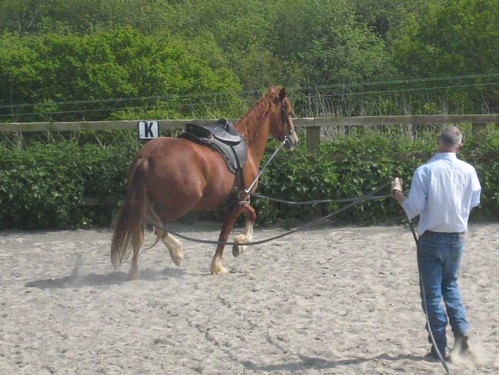
Moving forward, but still anxious- notice the gorgeous Section D leg action here.
This work continued on Saturday, with more discussion of leadership and how it is much easier for the horse to be directed than for them to make their own decisions. What we consider generous in terms of allowing freedom (and maybe our whole idea of freedom) is not really helpful to horses. The same goes for cues- by making them really definite we make it very clear what we want and so much easier for the horse to get right.

Much more settled on the long-lines.
Whenever Leia was trying to go somewhere Tom was turning her away to keep reminding her about the new rule about who chooses her direction. He also talked about using voice cues, suggesting that if you're going to use them you want something you can keep the pressure on with so "walk on" has a definite ending whereas if you're asking with a "ch-ch-ch-ch" type sound you can keep that going until you get what you want and then stop- pressure and release in another form.
The next session they continued with the lines again, but rather than working off a halter they introduced her to the bridle. Tom advised Sarah on staying calm if the horse got anxious- just think about the job and don't buy in to the horse's drama. While they worked Sarah was talking about how they work with a lot of ponies off dartmoor (they are based in Devon) and how there is a transition with wild horses between the time when you need to do anything you can just to show that humans are not going to harm them and the time when you need to get down to business and start giving them a job to do. That transition happens much earlier than you might expect.
In the last session they continued in a similar vein but set up a lot more obstacles for Sarah and Leia to work around. Tom emphasised the importance of not leaving the horse alone- if they are having the thought that they can't do something you need to make sure you give them a little direction or reminder that you're there with them. It's a very simple idea but a very useful one.

By the end of the session Leia was long-lining around and over poles and between cones with Sarah guiding her through and around really controlling her direction and with her staying remarkably calm considering how she had started a few days before.
By contrast with Leia, Gold Dust, Kerin's lovely three-year-old Trakehner filly is one of the calmest horses you could hope to meet. The first session of this clinic was also her first time in the school and she was a bit jumpy to start with- especially as her regular field was just down the hill from the school and one of her fieldmates was making a terrible fuss the whole time she was there.
They started working on the line, letting her move her feet and calming it to gentle circles in much the same way as has been mentioned elsewhere. They then moved on to the yielding exercise turning the horse from the rope around it's quarters- I'm sure that has a name but it eludes me. It took Gold Dust only a couple of tries to get the hang of this. Sarah explained how quickly they start acting without thinking in this kind of exercise- once you've got the basic maneuvre right you can test how much you have really understood by asking the horse to do it one step at a time.

Tom, Gold Dust and Kerin.

I know she was actually scratching her ear, but I like the idea that Gold Dust is doing some bizarre capering dance for Tom's amusement here.
In all the work they did Tom suggested that Kerin makes sure she gets exactly the paces she wants right from the start - as with Leia this is the ideal time to instill a work ethic in the horse. Gold Dust actually arrived with a pretty impressive work ethic but by this point she was very tired so that was the end of her session.
They were first up on Friday morning where they were doing another short, gentle, session to help establish the school as somewhere positive and safe for Gold Dust. They worked on backing up, not just asking for a step of back but once the horse understands the cue to keep backing up until the horse offers it softly. When that happens they are relaxed and the experience is more positive for you.
In their next session they worked on finding tasks for her to do, setting out a maze of poles for her to walk down or back up out of, asking her across a tarpaulin and so on. Crossing the tarp is a useful exercise because it's not about the crossing it's about establishing a solid forward cue. It's a great preparatory exercise for loading in that respect. They worked on getting her moving forward- once Kerin asked her to go forward she was commited and she had to make sure she got it.
They did more work between cones and the fence, Kerin working from a driving position ( approximately level with the hindquarters ) and asking her to move between a single cone and the fence and then weaving through a line of cones. None of these things seemed to worry Gold Dust at all, she just took it all in her stride.
In her final session they got her starting to work in long-lines, giving Kerin plenty of things to work on towards her start. Tom talked about what a great opportunity it is when you have someone with Kerin's level of skill to be able to give a horse a really solid start rather than having a horse that comes with a whole lot of other people's bad training and consequent emotional baggage. Gold Dust worked hard and it was very clear what a brilliant horse she is going to be with this kind of start.

Very calm with the surcingle on.
Maple is Brenda's first horse, an absolutely adorable very experienced and laid back cob mare. Brenda bought her about three months ago - it was really nice to see someone with a first horse as ideally suited to the job as Maple is.

Brenda and Maple.
Although Brenda has been riding for a few years she doesn't have as much experience of the regular handling work so they started on basic groundwork, starting with asking Maple to stand still. This is one of those small changes that makes a big difference to the horse. As Tom said; it may look like you're almost literally doing nothing but if you spend half an hour teaching your horse to stand still that is half an hour very well spent. Which reminds me, I really should do that with Zorro.
Tom also embarked on one of his characteristic rants on the topic of pet horses. In the past if you were a doctor who needed to get to a patient you didn't pander to your horse's quirks, you put a saddle on and got to that patient as fast as you could. As horses have become more strictly leisure animals (in this country at least) people have lost the businesslike approach that is actually one of the best things from the horse's point of view.
Being considerate to your horse is a nice idea, but what we think of as considerate is not necessarily how the horse sees it. If you leave the horse with too much responsibility then they will learn to take charge and that isn't a healthy situation.

Working to get Brenda's leading really definite.
Tom also talked about the difference between technique and feel- particularly at the start we really want to latch on to techniques but what we need is to become the person the horse will respond to. If you're trying to use any technique and the horse's attention is somewhere off in the far fields then there's no real value in it for either of you. Better to get them with you and not worry about any given method at all. Until you have the simple stuff down really well why worry about the complex stuff? Horsemanship, he observed, is not a psychic event. We use phrases like "be more there" but all it really means is just do something to show the horse that you are with them.

The yeildy turning exercise thing.
The next session they worked in the saddle- like all the riding horses there, Maple was running through the bit. When Brenda asked her to halt her feet were stopping but she was pushing on through it. They started working on this at halt- Maple has had a lifetime of running through the bit and it's going to be quite a big deal for her to change all that, she has to go back and learn the basics.
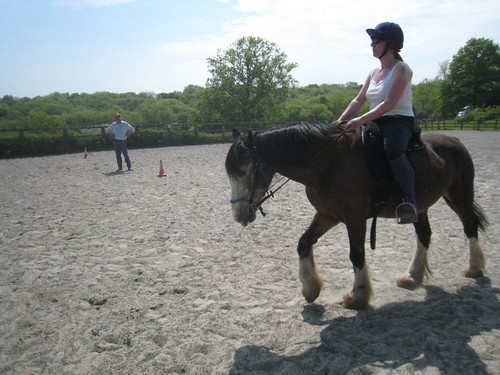
Working in the saddle.
The essence of this bit work is never releasing on a pull or you will teach the horse to pull. You just wait for them to give and then give them the whole rein ( at first ) or soften it as you go on and get a bit more communication going on there, so you're not just dropping the horse.
She was also tending to move off from the mounting block and while Brenda was dismounting- for any unwanted movement in the saddle it's best to turn the horse in a circle until they choose to stop. If you make them stop then they won't learn from it, but if you set things up so they can choose to stop or choose to keep going and they find that keeping going is hard and when they stop they get a big release of pressure then they're going to work that out for themselves pretty quickly.

Tom working to get Maple moving forward and listening.
The next day Tom observed that Brenda was tending to underestimate herself, to see her mistakes more than her successes. If you do that you set yourself up to fail so Tom declared it "Fabulous Brenda" day and made it known there was a standard fine of £5.00 (or possibly £20.00 - I got confused about that, it may have gone up, inflation is a terrible thing ) for every time Brenda put herself down. The important thing is to stay calm and to take the braces out of the situation- in people as much as in horses. And both calmness and softness in both derive from confidence.

They worked on softening to the rein from the ground, to each side and softening to an ask on both reins. By this time Tom felt Brenda needed to be making herself really precise and not cutting the horse any slack. That's not the same as being jerky or overdoing things, just being clear and definite in what you want and getting it. She felt she had been a passenger on Maple ( partly because it was so different having her own horse rather than riding on school horses ) and it was time to change to be a leader instead.
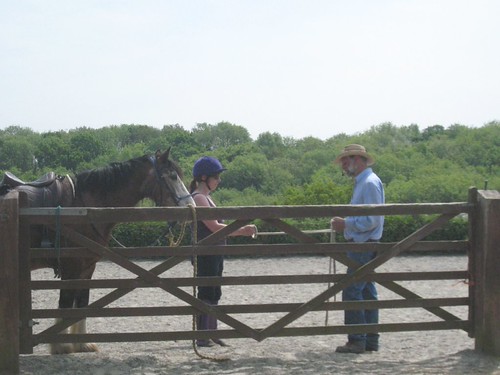
Tom shows Brenda how she can offer more softness through the rein.
Maple was really bracing heavily on the corners so Tom had Brenda ride her around a set of cones, putting in so many turns that there was no benefit to her in bracing against that rein cue. All this softening work is an ongoing process and you need to keep the work going if there is going to be any benefit to it. Maple was relaxing quite nicely in walk, so they tried a bit of trotting, where some of the braces returned. Tom observed that this is to be expected as you work in faster paces but the same consistent approach will bring the same results and once they have the idea of working softly it can be a little easier in other paces. It remains a long term exercise.

Working around the cones.
It seemed to me that Brenda made some really big steps in her horsemanship over the clinic and I think that she and Maple have a foundation for being a really great team.
This was a tough one to watch, though not nearly as tough as it was to be part of I'm sure. Ted, who was only with us for the last two days, is a massive and spectacular fresian. A truly dramatic horse- the camera absolutely loves him - but deeply deeply troubled. His previous owners were total novices and handled him so badly that it would have been hard to have made his life more difficult through all-out deliberate malice. They tied his head down, beat him with a length of plastic pipe and thought it was brilliant when he chased things around the field. As a result they taught him to be aggressive and that he needed to get his attack in first because humans were going to be bad news for him. Vicki has spent the last few months since she got him doing everything she can to get him settled at home, but he remains dangerous and unpredictable.
After years of working with troubled horses Tom has quite understandably stepped back from that line of work but he did what he could to help them get a bit of foundation between them.
They started out working on leading and backing up, working to protect Vicki's personal space. She had been taught to shank Ted with the rope to back him off her, which might be effective but is also hard for a horse to understand and potentially aggravating. Tom had her asking him softly for back-up with steady pressure. He avoided the more confrontational approach to keeping the horse out of one's personal space that he tends to adopt, partly because Ted is already very good at confrontation and partly because Tom felt that Ted had already had a lot of strong and confusing handling and he had a better chance of getting through to him by asking for things more softly. Ted tends to want to be quite bitey or rub his head on her so Tom suggested that Vicki keep him at a bit of a distance when they were stopped so that he didn't have the opportunity to bite her.

Ted and Vicki
They worked with leading, getting Vicki to use the whole length of the rope and leave a hand behind her well up the rope so that if he was going to run into her he would run into the hand first. They discussed control of the feet and how important that is to horses- every time Ted allows Vicki to move his feet then he has accorded her a little bit of leadership. This is going to be a very long project for her but these small things will add up in the long term.

Ted leading nicely.
As with many of the young horses Tom moved on to ask him to work at a gentle walk on the lunge. Ted pretty much exploded at this with feet and feathers flying everywhere. Tom just stayed where he was, put a bit more energy on the rope when Ted got closer and more or less ignored the drama and waited for the calm horse to come back. By not putting any more energy in than Ted was, Tom aimed to avoid being the one who was escalating the drama. He observed that Ted really wants the calm, he doesn't want to be trapped by his past and the more Vicki can offer it the happier he will be. Ted is really worried that he's going to get a response he can't understand from his handler. If Vicki can handle him with absolute consistency and in a way he can really understand then he will be a whole lot more settled. One of the problems he has is that he can't handle it when people get frightened, but he can also be very frightening.

Ted has a bit of a fresian moment...

...

...

...

...

...

...and comes back. I hasten to add that Tom wore a hard-hat for all their subsequent sessions.
On Sunday Ted was a bit more settled in his environment, which made him considerably more punchy. Vicki's experience has been that with his tack on he has a job he understands a little better ( his former owners rode him very rarely so probably this harks back to earlier training ) but he wasn't interested in going anywhere near his saddle or bridle. Vicki said he was normally alright in the stable to tack up ( but only if you put his bridle on first ) but obviously the different setting had affected him quite strongly. Tom suggested not worrying about that for now- if he is happy to tack up in the stable then do it there and worry about the real problem of getting his head straight. Once that is done many of the other problems he has are likely to disappear.
Asking for the same work on the line was very explosive indeed, Ted would work nicely for a few strides then pretty much completely flip out, going for Tom with whatever feet or teeth were nearest. Tom just kept calm and used the rope to keep him out, reflecting back the amount of energy that Ted was putting in. Tom made the point again that this is a very long term job- Ted is not a horse that will be cured in 20 minutes- after all, it didn't take 20 minutes for him to get the way he is. Tom talked about using a stick and explained that he doesn't do that because anything percussive like that has no real pressure and release element to it so it's very hard to teach the horse with. Something that can keep the pressure on and release at the right time is much easier for them to understand.
One thing that was interesting was Tom explaining that the problem with one of the ways Vicki had been taught to move Ted back, by pushing towards his head, is that it's very close to how colts play their fighting games. Ted would be only too happy to play that type of game, but it may not go so well for Vicki if he does.
In their last session they worked on just leading around the path past the school and into and out of his pen, trying to engage his interest and keep things calm and positive for him.
It was interesting, sad and nerve-wracking to watch. Tom reiterated that Vicki has a really big job ahead of her. Ideally she needs to be the only person handling him ever and he could really use going out in a field with some other horses and just having some serious horse time. She's already done an amazing job getting him as far as she has, but he remains dangerous and unpredictable and there are years of calm, brave, difficult work ahead of her.
My big ambition for the clinic was to work on getting Zorro and I moving a bit more forward, particularly under saddle. Tom seemed to really take to the big guy, saying he was really a 90% horse, but there was just that 10% of wild animal still in there which is where my problems were coming from.
We started out on the Thursday by working to get my cues a lot more accurate - Tom observed that I was doing fine in general but I was leaving way too many grey areas in my requests. What Zorro needed was for me to be saying "we are doing this and we are doing it now!" We worked on the lunge with me keeping the idea that I would accept no slow steps from him- I would expect exactly the gait I wanted from the start and if he didn't offer it I would put more pressure on until he did, typically using a spin on the rope. Tom recommended spinning the rope so that the upwards turn is beside the horse as a way of conveying an "upwards" kind of a feel to it. Honestly, I'm not sure how much of a difference it makes, but it was no worse than the way I was doing things before.

Getting Zorro forward on the line.
In the afternoon, working with Sarah, we carried on with the lunging. Sarah suggested that Zorro was kind of leaning on the energy I was putting in to keep him going, so that I was feeling I had to constantly be pushing him on and that he would peter out entirely if I didn't. This is a clear reflection of my personality- very willing to put a lot of effort in for the people I care about but leaving myself open to exploitation as a result. It doesn't bother me because I would rather do too much for people than too little, but it's no way to be with horses. What Zorro needed was for me to be effective when I was asking and to let the pressure off when he was getting it right. That eliminates unnecessary noise from me and makes it very clear when I want something to change. Amazingly this was after having deliberately worked on trying to be less naggy in my cues for some time- goodness only knows how bad I was before.
The big thing I took from the day was that Zorro really needs me to be absolutely black and white in what I ask him for and how I ask for it.
On Friday after warming up with some of the same lungeing work ( which was much better after a night for us to sleep on it) I got into the saddle and we worked to replicate the same changes in my riding, making my cues more effective and making sure I didn't accept any slow steps from Zorro. It was quickly clear I was going to need to back up my forward cue, so I got my bit of string, which I usually use as backup and added that to my regular leg cue when Zorro didn't respond promptly and with enough forward.

Zorro finds a little more forwards.
It really didn't take much work in that vein to get him reacting very quickly and nicely off the leg. Working wider in the school (which is a very good size) Zorro kept wanting to bring me back to the gate so we also worked on that, turning him away and making it clear that it doesn't work. There were a few little stroppy bucks while he shared his opinions on that idea but with a bit of perseverence he started to get the idea that I could ask him to go places and it was easier to just go there.
One thing that was very interesting was that even though I have been spending so much time with Julian learning to ride well by using my seat solely to absorb the movement of the horse, I was still trying to push with my own horse. I suddenly noticed this as we started to get more forward and it occurred to me that I had been feeling that if I didn't Zorro would just peter out altogether. He had got me very well trained- as Tom commented I really was putting in 80% of the effort to get 20% of the outcome and changing that around was a big deal for Zorro and I. He also mentioned that probably my endeavours to push from my seat were blocking Zorro and making him even slower.
On Saturday, having got the forward working nicely, we began to work on teaching him about the bit. This hasn't really been a problem in the past because I've been content to ride on the halter, which he does understand, and only using the bridle when we are riding out, when he just ambles along and it doesn't really present a problem. Tom let me know before we started that I need to be aware that if I start this job I'm committed to following it through.
Now we had a great opportunity to work on it, which we began (much as with Maple and Jester) by asking him to give to the bit at halt, just picking up the rein and letting him find that softening his neck brings him release. If he wasn't giving and just seemed to be settling to pull then I needed to be doing something to change what I was asking to keep him looking for that release. Having a soft halt is important because you really want a horse that can go off in any direction when you ask them to and while the horse is leaning on your hand there is essentially no way that they can strike off with their hind feet so you're going to be on the forehand right from the start.
He was also bracing on corners and the solution was much the same, give him the outside rein and set the inside one and then not release while he was braced. That could mean quite a few circles before he just let the softness stay in the rein, at which point we could move off forward again.
In the afternoon we were able to start working on getting the same thing at walk- this was only possible because we had established forward well by this point- if we hadn't the pressure I was putting on the reins would have just meant "stop" as far as Zorro was concerned. He was tending to dive on the bridle when I released him, trying to pull the reins through my fingers. Tom's recommended response to this was to just keep the idea of the post and fix one rein so he runs into his own pressure on one side when he does it. By the end of the session we were starting to get a few good steps without him pulling on the bridle and even continuing to offer softness after I gave him the rein back, which I was very impressed with.

Zorro tries pushing on the bit...

...finds that he can just yield to it instead.
Tom also talked about how I needed to take more control with Zorro when we weren't working- if I really clamp down on some of his more insubordinate behaviours hard, rather than just gently stopping him, then he'll be more willing to accept my leadership in general. A few small changes in really reacting strongly when he wanted to dive on grass while I was tacking him up or trying to rub his head on me rather than just shoving him away made a surprisingly large immediate difference to his outlook. These little things are what will make the jump from being a 90% horse to a 100% horse.
On Sunday we basically tried to really consolidate the work we already had. Zorro was able to offer me softness quite consistently at walk and even sometimes at trot. We even had one halt where after Tom had finished explaining something I picked the rein up and Zorro immediately softened and stood in perfect balance, ready to go wherever I asked him. It was an absolutely amazing feeling.
All in all it was a truly fantastic clinic and I think we all got a huge amount out of it. This time around they were really just getting all of us working on the basics and a lot of what I describe may seem obvious to some people but actually when you're there with your own horse having an expert pair of eyes on the ground makes an enormous difference. And if you have the basics right then you have the important part of your horsemanship sorted out right there. It's a pleasure to learn from teachers with such an ability to demystify and simplify the things you really need to learn, and who can present the information in such an entertaining way while they do it.
This was a four day clinic with most horse and rider pairs getting two sessions per day, one longer exclusive one in the morning and then having two pairs working at opposite ends of the (sizeable) school in the afternoon, one with Sarah, the other with Tom. We had an interesting mix of baby horses, older more seen-it-all ponies, Zorro and I somewhere in the middle and one very troubled horse, who was only around for the last two days.
To keep things flowing and easy to follow, I will talk about this clinic horse by horse, which will hopefully make it easier to see how everyone progressed over the four days. I'm sorry to say that my camera went flat about half way through so there are fewer pictures from the last couple of days although the ones I have are slightly better cos I borrowed our friend's very classy SLR and stuck my SD card in it. Also, I've tended to choose pictures that I liked as pictures so they're not always terribly informative and don't necessarily follow what I'm talking about...
The themes of the clinic were very much on solid basics, finding softness by working through braces and on helping horses to feel secure by making it easy to understand what you are asking for.
Brian and Trevor
Brian ( right up there with "Attack Baby" on my list of favourite horse names ) is a four year old fresian- bought from an importer as a recently backed riding horse. Trevor, much like me a couple of years ago, was introduced to horses by his girlfriend Janet ( who brought little Seamus to the previous clinic ) and has totally fallen for them. They were of the opinion that Brian is not nearly as comfortable being ridden as the dealer had suggested and after some anxious moments on his part had decided it was probably worth restarting him altogether.
Brian and Tom.
Tom started by getting Trevor to really guard his personal space, working on leading, stopping and backing Brian away. Also asking Brian to just stay still, so he can understand he doesn't have to be moving his feet the whole time and that he doesn't need to be pushing on Trevor's space. By looking for the thought about moving and keeping the horse's attention it's very easy to set things up so they can keep their focus on you and you can keep them in the right place without having to put in too much energy and risk making them agitated. Standing still at the end of the line is still a job that the horse should be able to do.
On the leading Brian was inclined to rush off, Tom observed that if your horse won't lead with you at your own speed then he's not really ready to ride. When the horse gives you something you don't want you need to correct it. With Brian it was clear that Trevor ( yes, those are both classic bloke's names and Tom did indeed keep getting them muddled up all weekend ) needed to be really enforcing those boundaries. As he started to do so Brian started to relax and drop his head.
They moved on to working on a circle, Tom asking initially for a simple walk on the line and stopping when he was asked. Brian tended to want to run off, Tom just wanted him to offer a nice relaxed walk- he commented that if you do the simple things right there is nothing difficult about horsemanship. This was very much a theme of the weekend- get the basics really solid and everything else will fall into place.
Brian on the lunge.
When Brian was tending to rush off ahead, Tom had Trevor just step towards his hindquarters a little to bring Brian's attention back as Trevor started leaving his field of view, which would also push him a little more round onto the circle. With Brian it was largely a case of ignoring his anxious moments when he felt like running off and just waiting for the good stuff to come along then really rewarding it by giving Brian a break after a bit of good walking and so on. All the horse really wants is an easy life and by making it easy for them to understand what we want we offer that.
Trevor leading Brian before they move on to long-lining.
Their second session began by working on the backup, trying to find softness and to make being with us the place that the horse can feel soft. Most horses will tend to brace a bit when asked to back up - it's important not to release while the horse is braced if you want them to learn to be soft. Once you've found something the horse braces against you need to find a way to release that brace before you release the pressure on the horse or they will just learn that braces work.
They went on to working on the long-lines. Brian found this a bit anxious at first but Tom just kept him turning and offering a consistent ask until Brian was able to offer him a steady walk. The long lines work well for helping a horse prepare for ridden work because we can ask for the same things that we want in the saddle.
Long lines were a little concerning at first...
But he soon settled.
They continued working on the long-lines in his third session. Tom was discussion how we can tend to give horses, especially horses who have had problems in the past, too much freedom, more than they know how to handle. They need to know there are limits and that we are in charge. Most horses find that very easy to accept.
Sarah talks them through some long-lining.
Brian was very keen to overbend- it looked like he had been worked in some kind of gadget to draw his head in and kept looking for release there. The solution to this was just to keep working and asking for a few steps and a halt with a natural head carriage. Keep working until it's right- he's smart enough to work out that putting his chin on his chest isn't working any more, but he'll need consistent work to really understand it.
Overbending.
Working nicely on the last day.
In their final session, after some very dramatic trotting on the long lines and much less overbending thanks to a mix of latent learning and an extra early morning long-lining session Brian was working really nicely. At the end of the session Trevor got back on him. Brian seemed quite content with the arrangement.
He can really trot.
A big moment for Brian and Trevor.
Because of some other personal commitments Trevor wasn't able to work on all the sessions in the clinic so he shared with Janet, who was playing with little Seamus. I don't have lot of notes from these sessions because they were quite late in the day, but I do have some pictures:
Seamus on the long lines.
Janet ponying Seamus off her older mare.
Ponying through an obstacle course.
Jester and Michaela
Jester and Tom.
Jester is a little black pony who has seen and done a lot of things in his life (pony club, jumping, general kids pony type life) and settled into a lowest-common-denominator life of doing the least effort he could get away with. He had been lucky enough to end up with Michaela who initially gave him some serious horsey time out in the field and then has brought him back into Endurance work, which he does a pretty good job of but he was still showing a lot of those traits of the older horse who has got a little shut down over the years.
They began by establishing personal space again. I noticed that any time Jester started to push on Tom's space he would get pushed back further than he moved to start with, so one step towards Tom would get pushed back several steps. It's a very simple system but absolutely effective.
Tom talked about wanting a push-button horse, how in the past he realised that he was riding wild horses and that it simply wasn't safe. One of the main themes of the weekend was the idea that you need your horse to be willing to allow you to direct them at all times. If you don't have that then you're sitting on a horse that has a certain amount of wild animal right in there. That's absolutely your right, but there's no point complaining if the wild side reveals itself at the most inopportune moment.
Once again the starting point was to set up a simple understandable job that Jester could understand and do. That would give him a reason to feel good about the work they were doing. The communication was all about simple pressure and release- you show the horse what you want and you put a little more pressure on when they're doing something else and release it as they get closer to what you are asking for.
Another repeating theme, and a phrase we heard a lot over the weekend, was "make it happen" - being an old hippy Tom really felt he should appologise for using the term, but it's a very useful way of thinking. Once you have decided your horse is going to do something you really need to make sure they do that thing. Most of us really needed to work on getting commitment into everything we asked of our horses. Because she lacked a bit of commitment when asking for her personal space Jester had effectively trained Michaela to back up.
On the lunge Jester was doing a lot of things more or less as distractions from the job in hand, dropping his head to the floor, bending to the outside anything but pay attention to the person in the middle of the circle. This is quite a common outcome of traditional lungeing which is usually done with an eye to the horse's phyical fitness rather than their mental fitness so the horse is just pushed around in circles indefinitely. Tom got Michaela working to get his attention back, making a noise, slapping the tail of the rope against her leg, stepping back towards his hind quarters and his blind spot, meaning he needs to turn in a little to be able to see her, really working to get him thinking about what he was doing and what she was asking. By looking for the first signs that he was thinking of taking his attention away and asking for it then it should be easier to bring it back.
While they worked on this Tom talked a lot about getting the horse with you, working voluntarily, not just doing what they are told because you are making them do it. At first you have to look for small tries - especially the horse giving up on their idea and taking on yours - and give them big rewards.
The next day they were working further on keeping his attention. They switched over to the rope halter as something he couldn't lean on as easily as his regular webbing one and had Michaela trying to be like a post- she doesn't pull on the rope if he starts to lean on it, she just doesn't yield so the horse runs into his own pressure. And when he comes back off it he releases himself. It's all about pressure and release.
Jester happy to charge about and not pay much attention...
...Tom just ignores the drama and asks him to get on with it.
Another hectic pony moment.
They worked on the lunge, doing quite a bit of canter as Jester has a stiff hip- he's had a lot of treatment for it and he gets through the endurance vet checks fine but he be a little unsound until he's warmed up. As he freed up his body his mind seemed to free up a little too. Tom commented that sometimes with horses there can be very little distinction between a mental or physical block.
Once he was warmed up, Michaela got on and they started doing some ridden work. Like most horses who haven't been explicitly taught about the bit Jester was pulling through his halts- his feet would stop but he would keep leaning on the bit. The starting point for all of the bit work we were doing over the weekend was keeping the pressure there until the horse softens. The essential part of Pressure and Release is that the point of release is when you tell the horse they are getting things right. If you release while the horse is braced then you're teaching the horse to brace. Most people have done that.
The bit is really important- it's a fantastic way of finding softness in a horse once they understand it, but while they don't understand it they can use it as a distraction from what you are asking them to do. If the horse leans on the bit in the halt it indicates they are still going forward mentally even if they have stopped their feet moving.
Teaching understanding of the bit is the first step to more advanced work- you need softness from the front to the back of the horse before you can get the horse working from the back to the front. A correctly used bit is a great way of finding softness in your horse and once they understand how it works and that you will use it in a logical and consistent way it can be very reassuring for them as well.
The starting point is not releasing on a brace, waiting for the horse to soften when you halt before you release. You don't pull on the rein, you just make your hands like a post so that the horse runs into their own pressure and then finds their own release- it's not a relative post either, it's as though you had put the reins over a post at your halt point- the more the horse goes forward the more they run into it. Jester was tending to lift his head up and fling it around when any pressure came on the bit, which is one classic reaction to a horse that doesn't really understand it. At first it was a case of waiting for him to stop pulling and give him the rein when he softened a little.
It's very easy to overdo this type of work - you need to be careful not to teach the horse to put their head on their chest as that is very difficult to undo.
On Saturday they began by revising the ground work- Michaela was being much more definite and precise but Jester kept coming trying things again, which suggested that she wasn't necessarily doing enough to change the behaviour. They worked on making it clear that he has crossed a boundary and really responding accordingly- as a guideline, if the horse hasn't moved their feet you probably need to be doing more if you're correcting something like invading your personal space, diving on grass during work time and so on.
When you have a horse with niggles they will sort out over time if you can present solid consistent horsemanship and you don't add to the confusion. Confusion is one of the main causes of problems that horses have.
In the saddle they worked on getting smoother transitions as Jester was tending to slightly throw himself into them- Tom talked about how if a horse overreacts on the transition it is probably because he feels he is being over-asked. They got some really good results, but Michaela was tending to ask for a little more than Jester could offer at that point - Tom's philosophy is that if you are doing a lot better in general now than you were previously then you should leave it at that rather than getting overly caught up in trying to correct every detail. Once the general picture is consistently right you can start building the details in bit by bit. If you try and do it all at once you're setting yourself and the horse up to fail. I guess it's a bit like if you had a staircase and you decided to pile all the steps on top of each other instead of leaving them stepped. At that point you've just got a wall and it's a whole lot harder to get up to the bathroom.
Jester and Michaela on the rampage.
Tom talks about doing the work and then letting it rest - "bank it" is a phrase he used a lot - and trying again tomorrow. Usually horses will be better after having had some time to think over what they have just done.
On the Sunday they were really working to get Jester to stop Zoning Michaela out- he was still really ignoring her on the lunge, working with a big brace to the outside - the classic shoulder-in-banana shape of a horse that has done a lot of lunging without having learned to lunge correctly.
Sarah spent a while with him on the lunge, really pushing him to pay attention- a lot of high energy stuff and quite a few protests from Jester, which were roundly ignored. With all the horses Tom and Sarah's reaction to something they hadn't asked for, especially the more explosive stuff, was essentially "that's nice, now why not get on with the job I'm asking you for?" The unwanted behaviour was basically ignored or a little more pressure was applied while it was going on until the horse could really understand what the job it was being asked for was and that it could do the job without making a fuss.
Jester is moving but he's not really paying Sarah any attention.
Still not a lot of attention.
They did some other work on keeping the horse's attention, working to stand with him and do something to bring his attention back any time it started to wander. After a little bit of work with this Sarah had him staying right with her on a loose rope, going exactly where she went and following her movement very precisely.
Sarah and Leia
Leia is a three-year-old Section D filly, who had never really been anywhere before. She was anxious, not only because of the new situation but because her whole disposition was strongly oriented towards the tremulous. This clinic was to be her first experience of work and the start of her backing process.
The immediate starting point was to find something simple to ask for and to keep asking until you got it. If the horse is on the other end of the line throwing themself around then that is fine, just keep the ask there and wait for something practical to come of it. From the very start Tom reccommended developing a good work ethic in the horse- if you instill a sloppy work ethic you'll only have to fix it later. For a young horse these first sessions are very important.
Leia was very flighty indeed so having got a bit of focussed work on the line Tom moved on to some sacking out, first holding the rope against her until she stopped trying to move away from it and the swinging it gently onto her. All of this is essential for developing a solid riding horse that doesn't run away from the saddle or react in unexpected ways if the rider bumps into them while mounting.
Starting on sacking out with a soft rope.
With the sacking out the important thing is to stop as soon as the horse makes the commitment to stop running away. Especially with a flighty horse like Leia she needs to know that running away is not the solution to the problem. Tom was keeping the sacking out going until she not only stopped moving but stopped quivering when the rope touched her- at that point she was clearly a little more able to cope with it. They went through the same exercises with a dishcloth and a plastic bag until Leia was able to accept all of them being touched all over her.
They moved onto the classic yielding exercise where you ask the horse to follow a feel from a rope around it's body. This is useful in various ways- as Tom teaches it you loop the rope over the horse's head and then move it along it's back step by step (hence this needing to be done after the sacking out ) until it is around their hind legs. Then by offering a gentle feel on the rope you ask the horse to turn around in a complete circle and come in to you. As well as helping them yield and follow a feel, this is a great exercise to prepare a horse for accepting long lines.
This is one part I actually did get to illustrate properly:

Passing the rope along the horse's back.
Asking for the head to turn away.
The feet start to follow the head.
Turning in towards Tom
And we're round
Because Leia is so young they did various things for short times- anything done for too long is likely to lose a young horse's attention and too much work on the circle can damage young joints.
Getting a bit anxious on the circle.
During their second session they did some similar work, starting on the circle and making sure that Sarah was able to bring Leia's attention back as it started wandering, rather than letting it get any further than that. By matching her feet to the horse's movement she could use her own paces to cue up the horse and get them both moving together so that when Leia was on a 10 metre circle Sarah was on a 7 meter circle inside it. Leia was making Sarah work quite hard to keep her attention, Tom recommended doing whatever was necessary to get it- making a noise or a sudden movement or generally doing something unexpected to make the horse feel it was worth paying attention back to her. He observed that with anything in horsemanship if you're having to do the same thing again and again then it's not working- this is the problem with the "kick-kick-kick" school of riding. When she started phasing Tom out he was slapping his leg with the rope, clicking her on or stamping his foot and kicking up a bit of sand to get her back to him.
They did a lot more sacking out using a rope and a flag (improvised from an old Parelli stick - the yard where the clinic was held is the old home of Parelli UK and they find all kinds of bits and bobs from the old owners ) to help her be a little braver. Tom explained how with really reactive horses if you don't do a lot of this type of work you end up with a horse you are perpetually having to go softly-softly around. He recommended using as many things as you can think of to desensitise the horse- don't take risks but on no account mollycoddle the horse. Much better to have half an hour of intense work and let the horse get through it than to have months of low-intensity work which is likely to be more stressful for them in the long term.
Sacking out with a flag- Leia is moving away here...
...slowing down and thinking about what is going on a bit more...
...until finally she can stand still and accept it.
With a horse that you think you need to be careful around you almost need to be deliberately careless- if you can be blase about things the horse might get anxious about you show them it's not a problem. If you react to them there's a good chance the horse will react in accord.
They moved on to working on the long-lines. Leia got a bit anxious with this at first but Tom just kept quietly and calmly asking her to change direction. At one point she got turned around so Tom let go of the outside line and just brought her back in, sorted the lines out and they started again. Tom talked about this as the point at which you "break" the horse, unapologetically using the traditional term, where you establish that the human controls the speed and direction of movement. This was where one pushes through the boundary from where the horse makes the decisions to where the human makes them- a line that absolutely needs to be crossed if you want a safe horse in the long run.
Running into the long-lines.
Moving forward, but still anxious- notice the gorgeous Section D leg action here.
This work continued on Saturday, with more discussion of leadership and how it is much easier for the horse to be directed than for them to make their own decisions. What we consider generous in terms of allowing freedom (and maybe our whole idea of freedom) is not really helpful to horses. The same goes for cues- by making them really definite we make it very clear what we want and so much easier for the horse to get right.
Much more settled on the long-lines.
Whenever Leia was trying to go somewhere Tom was turning her away to keep reminding her about the new rule about who chooses her direction. He also talked about using voice cues, suggesting that if you're going to use them you want something you can keep the pressure on with so "walk on" has a definite ending whereas if you're asking with a "ch-ch-ch-ch" type sound you can keep that going until you get what you want and then stop- pressure and release in another form.
The next session they continued with the lines again, but rather than working off a halter they introduced her to the bridle. Tom advised Sarah on staying calm if the horse got anxious- just think about the job and don't buy in to the horse's drama. While they worked Sarah was talking about how they work with a lot of ponies off dartmoor (they are based in Devon) and how there is a transition with wild horses between the time when you need to do anything you can just to show that humans are not going to harm them and the time when you need to get down to business and start giving them a job to do. That transition happens much earlier than you might expect.
In the last session they continued in a similar vein but set up a lot more obstacles for Sarah and Leia to work around. Tom emphasised the importance of not leaving the horse alone- if they are having the thought that they can't do something you need to make sure you give them a little direction or reminder that you're there with them. It's a very simple idea but a very useful one.
By the end of the session Leia was long-lining around and over poles and between cones with Sarah guiding her through and around really controlling her direction and with her staying remarkably calm considering how she had started a few days before.
Kerin and Gold Dust
By contrast with Leia, Gold Dust, Kerin's lovely three-year-old Trakehner filly is one of the calmest horses you could hope to meet. The first session of this clinic was also her first time in the school and she was a bit jumpy to start with- especially as her regular field was just down the hill from the school and one of her fieldmates was making a terrible fuss the whole time she was there.
They started working on the line, letting her move her feet and calming it to gentle circles in much the same way as has been mentioned elsewhere. They then moved on to the yielding exercise turning the horse from the rope around it's quarters- I'm sure that has a name but it eludes me. It took Gold Dust only a couple of tries to get the hang of this. Sarah explained how quickly they start acting without thinking in this kind of exercise- once you've got the basic maneuvre right you can test how much you have really understood by asking the horse to do it one step at a time.
Tom, Gold Dust and Kerin.
I know she was actually scratching her ear, but I like the idea that Gold Dust is doing some bizarre capering dance for Tom's amusement here.
In all the work they did Tom suggested that Kerin makes sure she gets exactly the paces she wants right from the start - as with Leia this is the ideal time to instill a work ethic in the horse. Gold Dust actually arrived with a pretty impressive work ethic but by this point she was very tired so that was the end of her session.
They were first up on Friday morning where they were doing another short, gentle, session to help establish the school as somewhere positive and safe for Gold Dust. They worked on backing up, not just asking for a step of back but once the horse understands the cue to keep backing up until the horse offers it softly. When that happens they are relaxed and the experience is more positive for you.
In their next session they worked on finding tasks for her to do, setting out a maze of poles for her to walk down or back up out of, asking her across a tarpaulin and so on. Crossing the tarp is a useful exercise because it's not about the crossing it's about establishing a solid forward cue. It's a great preparatory exercise for loading in that respect. They worked on getting her moving forward- once Kerin asked her to go forward she was commited and she had to make sure she got it.
They did more work between cones and the fence, Kerin working from a driving position ( approximately level with the hindquarters ) and asking her to move between a single cone and the fence and then weaving through a line of cones. None of these things seemed to worry Gold Dust at all, she just took it all in her stride.
In her final session they got her starting to work in long-lines, giving Kerin plenty of things to work on towards her start. Tom talked about what a great opportunity it is when you have someone with Kerin's level of skill to be able to give a horse a really solid start rather than having a horse that comes with a whole lot of other people's bad training and consequent emotional baggage. Gold Dust worked hard and it was very clear what a brilliant horse she is going to be with this kind of start.
Very calm with the surcingle on.
Brenda and Maple
Maple is Brenda's first horse, an absolutely adorable very experienced and laid back cob mare. Brenda bought her about three months ago - it was really nice to see someone with a first horse as ideally suited to the job as Maple is.
Brenda and Maple.
Although Brenda has been riding for a few years she doesn't have as much experience of the regular handling work so they started on basic groundwork, starting with asking Maple to stand still. This is one of those small changes that makes a big difference to the horse. As Tom said; it may look like you're almost literally doing nothing but if you spend half an hour teaching your horse to stand still that is half an hour very well spent. Which reminds me, I really should do that with Zorro.
Tom also embarked on one of his characteristic rants on the topic of pet horses. In the past if you were a doctor who needed to get to a patient you didn't pander to your horse's quirks, you put a saddle on and got to that patient as fast as you could. As horses have become more strictly leisure animals (in this country at least) people have lost the businesslike approach that is actually one of the best things from the horse's point of view.
Being considerate to your horse is a nice idea, but what we think of as considerate is not necessarily how the horse sees it. If you leave the horse with too much responsibility then they will learn to take charge and that isn't a healthy situation.
Working to get Brenda's leading really definite.
Tom also talked about the difference between technique and feel- particularly at the start we really want to latch on to techniques but what we need is to become the person the horse will respond to. If you're trying to use any technique and the horse's attention is somewhere off in the far fields then there's no real value in it for either of you. Better to get them with you and not worry about any given method at all. Until you have the simple stuff down really well why worry about the complex stuff? Horsemanship, he observed, is not a psychic event. We use phrases like "be more there" but all it really means is just do something to show the horse that you are with them.
The yeildy turning exercise thing.
The next session they worked in the saddle- like all the riding horses there, Maple was running through the bit. When Brenda asked her to halt her feet were stopping but she was pushing on through it. They started working on this at halt- Maple has had a lifetime of running through the bit and it's going to be quite a big deal for her to change all that, she has to go back and learn the basics.
Working in the saddle.
The essence of this bit work is never releasing on a pull or you will teach the horse to pull. You just wait for them to give and then give them the whole rein ( at first ) or soften it as you go on and get a bit more communication going on there, so you're not just dropping the horse.
She was also tending to move off from the mounting block and while Brenda was dismounting- for any unwanted movement in the saddle it's best to turn the horse in a circle until they choose to stop. If you make them stop then they won't learn from it, but if you set things up so they can choose to stop or choose to keep going and they find that keeping going is hard and when they stop they get a big release of pressure then they're going to work that out for themselves pretty quickly.
Tom working to get Maple moving forward and listening.
The next day Tom observed that Brenda was tending to underestimate herself, to see her mistakes more than her successes. If you do that you set yourself up to fail so Tom declared it "Fabulous Brenda" day and made it known there was a standard fine of £5.00 (or possibly £20.00 - I got confused about that, it may have gone up, inflation is a terrible thing ) for every time Brenda put herself down. The important thing is to stay calm and to take the braces out of the situation- in people as much as in horses. And both calmness and softness in both derive from confidence.
They worked on softening to the rein from the ground, to each side and softening to an ask on both reins. By this time Tom felt Brenda needed to be making herself really precise and not cutting the horse any slack. That's not the same as being jerky or overdoing things, just being clear and definite in what you want and getting it. She felt she had been a passenger on Maple ( partly because it was so different having her own horse rather than riding on school horses ) and it was time to change to be a leader instead.
Tom shows Brenda how she can offer more softness through the rein.
Maple was really bracing heavily on the corners so Tom had Brenda ride her around a set of cones, putting in so many turns that there was no benefit to her in bracing against that rein cue. All this softening work is an ongoing process and you need to keep the work going if there is going to be any benefit to it. Maple was relaxing quite nicely in walk, so they tried a bit of trotting, where some of the braces returned. Tom observed that this is to be expected as you work in faster paces but the same consistent approach will bring the same results and once they have the idea of working softly it can be a little easier in other paces. It remains a long term exercise.
Working around the cones.
It seemed to me that Brenda made some really big steps in her horsemanship over the clinic and I think that she and Maple have a foundation for being a really great team.
Vicki and Ted
This was a tough one to watch, though not nearly as tough as it was to be part of I'm sure. Ted, who was only with us for the last two days, is a massive and spectacular fresian. A truly dramatic horse- the camera absolutely loves him - but deeply deeply troubled. His previous owners were total novices and handled him so badly that it would have been hard to have made his life more difficult through all-out deliberate malice. They tied his head down, beat him with a length of plastic pipe and thought it was brilliant when he chased things around the field. As a result they taught him to be aggressive and that he needed to get his attack in first because humans were going to be bad news for him. Vicki has spent the last few months since she got him doing everything she can to get him settled at home, but he remains dangerous and unpredictable.
After years of working with troubled horses Tom has quite understandably stepped back from that line of work but he did what he could to help them get a bit of foundation between them.
They started out working on leading and backing up, working to protect Vicki's personal space. She had been taught to shank Ted with the rope to back him off her, which might be effective but is also hard for a horse to understand and potentially aggravating. Tom had her asking him softly for back-up with steady pressure. He avoided the more confrontational approach to keeping the horse out of one's personal space that he tends to adopt, partly because Ted is already very good at confrontation and partly because Tom felt that Ted had already had a lot of strong and confusing handling and he had a better chance of getting through to him by asking for things more softly. Ted tends to want to be quite bitey or rub his head on her so Tom suggested that Vicki keep him at a bit of a distance when they were stopped so that he didn't have the opportunity to bite her.
Ted and Vicki
They worked with leading, getting Vicki to use the whole length of the rope and leave a hand behind her well up the rope so that if he was going to run into her he would run into the hand first. They discussed control of the feet and how important that is to horses- every time Ted allows Vicki to move his feet then he has accorded her a little bit of leadership. This is going to be a very long project for her but these small things will add up in the long term.
Ted leading nicely.
As with many of the young horses Tom moved on to ask him to work at a gentle walk on the lunge. Ted pretty much exploded at this with feet and feathers flying everywhere. Tom just stayed where he was, put a bit more energy on the rope when Ted got closer and more or less ignored the drama and waited for the calm horse to come back. By not putting any more energy in than Ted was, Tom aimed to avoid being the one who was escalating the drama. He observed that Ted really wants the calm, he doesn't want to be trapped by his past and the more Vicki can offer it the happier he will be. Ted is really worried that he's going to get a response he can't understand from his handler. If Vicki can handle him with absolute consistency and in a way he can really understand then he will be a whole lot more settled. One of the problems he has is that he can't handle it when people get frightened, but he can also be very frightening.
Ted has a bit of a fresian moment...
...
...
...
...
...
...and comes back. I hasten to add that Tom wore a hard-hat for all their subsequent sessions.
On Sunday Ted was a bit more settled in his environment, which made him considerably more punchy. Vicki's experience has been that with his tack on he has a job he understands a little better ( his former owners rode him very rarely so probably this harks back to earlier training ) but he wasn't interested in going anywhere near his saddle or bridle. Vicki said he was normally alright in the stable to tack up ( but only if you put his bridle on first ) but obviously the different setting had affected him quite strongly. Tom suggested not worrying about that for now- if he is happy to tack up in the stable then do it there and worry about the real problem of getting his head straight. Once that is done many of the other problems he has are likely to disappear.
Asking for the same work on the line was very explosive indeed, Ted would work nicely for a few strides then pretty much completely flip out, going for Tom with whatever feet or teeth were nearest. Tom just kept calm and used the rope to keep him out, reflecting back the amount of energy that Ted was putting in. Tom made the point again that this is a very long term job- Ted is not a horse that will be cured in 20 minutes- after all, it didn't take 20 minutes for him to get the way he is. Tom talked about using a stick and explained that he doesn't do that because anything percussive like that has no real pressure and release element to it so it's very hard to teach the horse with. Something that can keep the pressure on and release at the right time is much easier for them to understand.
One thing that was interesting was Tom explaining that the problem with one of the ways Vicki had been taught to move Ted back, by pushing towards his head, is that it's very close to how colts play their fighting games. Ted would be only too happy to play that type of game, but it may not go so well for Vicki if he does.
In their last session they worked on just leading around the path past the school and into and out of his pen, trying to engage his interest and keep things calm and positive for him.
It was interesting, sad and nerve-wracking to watch. Tom reiterated that Vicki has a really big job ahead of her. Ideally she needs to be the only person handling him ever and he could really use going out in a field with some other horses and just having some serious horse time. She's already done an amazing job getting him as far as she has, but he remains dangerous and unpredictable and there are years of calm, brave, difficult work ahead of her.
Zorro and I
My big ambition for the clinic was to work on getting Zorro and I moving a bit more forward, particularly under saddle. Tom seemed to really take to the big guy, saying he was really a 90% horse, but there was just that 10% of wild animal still in there which is where my problems were coming from.
We started out on the Thursday by working to get my cues a lot more accurate - Tom observed that I was doing fine in general but I was leaving way too many grey areas in my requests. What Zorro needed was for me to be saying "we are doing this and we are doing it now!" We worked on the lunge with me keeping the idea that I would accept no slow steps from him- I would expect exactly the gait I wanted from the start and if he didn't offer it I would put more pressure on until he did, typically using a spin on the rope. Tom recommended spinning the rope so that the upwards turn is beside the horse as a way of conveying an "upwards" kind of a feel to it. Honestly, I'm not sure how much of a difference it makes, but it was no worse than the way I was doing things before.
Getting Zorro forward on the line.
In the afternoon, working with Sarah, we carried on with the lunging. Sarah suggested that Zorro was kind of leaning on the energy I was putting in to keep him going, so that I was feeling I had to constantly be pushing him on and that he would peter out entirely if I didn't. This is a clear reflection of my personality- very willing to put a lot of effort in for the people I care about but leaving myself open to exploitation as a result. It doesn't bother me because I would rather do too much for people than too little, but it's no way to be with horses. What Zorro needed was for me to be effective when I was asking and to let the pressure off when he was getting it right. That eliminates unnecessary noise from me and makes it very clear when I want something to change. Amazingly this was after having deliberately worked on trying to be less naggy in my cues for some time- goodness only knows how bad I was before.
The big thing I took from the day was that Zorro really needs me to be absolutely black and white in what I ask him for and how I ask for it.
On Friday after warming up with some of the same lungeing work ( which was much better after a night for us to sleep on it) I got into the saddle and we worked to replicate the same changes in my riding, making my cues more effective and making sure I didn't accept any slow steps from Zorro. It was quickly clear I was going to need to back up my forward cue, so I got my bit of string, which I usually use as backup and added that to my regular leg cue when Zorro didn't respond promptly and with enough forward.
Zorro finds a little more forwards.
It really didn't take much work in that vein to get him reacting very quickly and nicely off the leg. Working wider in the school (which is a very good size) Zorro kept wanting to bring me back to the gate so we also worked on that, turning him away and making it clear that it doesn't work. There were a few little stroppy bucks while he shared his opinions on that idea but with a bit of perseverence he started to get the idea that I could ask him to go places and it was easier to just go there.
One thing that was very interesting was that even though I have been spending so much time with Julian learning to ride well by using my seat solely to absorb the movement of the horse, I was still trying to push with my own horse. I suddenly noticed this as we started to get more forward and it occurred to me that I had been feeling that if I didn't Zorro would just peter out altogether. He had got me very well trained- as Tom commented I really was putting in 80% of the effort to get 20% of the outcome and changing that around was a big deal for Zorro and I. He also mentioned that probably my endeavours to push from my seat were blocking Zorro and making him even slower.
On Saturday, having got the forward working nicely, we began to work on teaching him about the bit. This hasn't really been a problem in the past because I've been content to ride on the halter, which he does understand, and only using the bridle when we are riding out, when he just ambles along and it doesn't really present a problem. Tom let me know before we started that I need to be aware that if I start this job I'm committed to following it through.
Now we had a great opportunity to work on it, which we began (much as with Maple and Jester) by asking him to give to the bit at halt, just picking up the rein and letting him find that softening his neck brings him release. If he wasn't giving and just seemed to be settling to pull then I needed to be doing something to change what I was asking to keep him looking for that release. Having a soft halt is important because you really want a horse that can go off in any direction when you ask them to and while the horse is leaning on your hand there is essentially no way that they can strike off with their hind feet so you're going to be on the forehand right from the start.
He was also bracing on corners and the solution was much the same, give him the outside rein and set the inside one and then not release while he was braced. That could mean quite a few circles before he just let the softness stay in the rein, at which point we could move off forward again.
In the afternoon we were able to start working on getting the same thing at walk- this was only possible because we had established forward well by this point- if we hadn't the pressure I was putting on the reins would have just meant "stop" as far as Zorro was concerned. He was tending to dive on the bridle when I released him, trying to pull the reins through my fingers. Tom's recommended response to this was to just keep the idea of the post and fix one rein so he runs into his own pressure on one side when he does it. By the end of the session we were starting to get a few good steps without him pulling on the bridle and even continuing to offer softness after I gave him the rein back, which I was very impressed with.
Zorro tries pushing on the bit...
...finds that he can just yield to it instead.
Tom also talked about how I needed to take more control with Zorro when we weren't working- if I really clamp down on some of his more insubordinate behaviours hard, rather than just gently stopping him, then he'll be more willing to accept my leadership in general. A few small changes in really reacting strongly when he wanted to dive on grass while I was tacking him up or trying to rub his head on me rather than just shoving him away made a surprisingly large immediate difference to his outlook. These little things are what will make the jump from being a 90% horse to a 100% horse.
On Sunday we basically tried to really consolidate the work we already had. Zorro was able to offer me softness quite consistently at walk and even sometimes at trot. We even had one halt where after Tom had finished explaining something I picked the rein up and Zorro immediately softened and stood in perfect balance, ready to go wherever I asked him. It was an absolutely amazing feeling.
All in all it was a truly fantastic clinic and I think we all got a huge amount out of it. This time around they were really just getting all of us working on the basics and a lot of what I describe may seem obvious to some people but actually when you're there with your own horse having an expert pair of eyes on the ground makes an enormous difference. And if you have the basics right then you have the important part of your horsemanship sorted out right there. It's a pleasure to learn from teachers with such an ability to demystify and simplify the things you really need to learn, and who can present the information in such an entertaining way while they do it.
![[identity profile]](https://www.dreamwidth.org/img/silk/identity/openid.png)
no subject
Date: 21 May 2008 20:34 (UTC)no subject
Date: 21 May 2008 21:18 (UTC)no subject
Date: 22 May 2008 15:04 (UTC)I have seen many angry horses, but Ted really saddened me,especially that horses are generally quite forgiving. I really hope that they manage to work things through - not every horse gets a second chance or someone that is willing to take them on in the sorry state that they're in.
Everytime I see you post pictures of Zorro and yourself, you've improved ten--fold - not to mention I adore your silk!
no subject
Date: 22 May 2008 23:34 (UTC)Turns out that silk is ideal for doing a proper dressage salute at the end of one's clinic session without having to remove one's hat :)
If you find this side of things interesting you may enjoy
This clinic
Date: 26 May 2008 09:53 (UTC)Firstly, I like to stress that these clinics are an opportunity to improve our horsemanship - this is what is going to make the long term difference to our horses.
Secondly, and this is kind of the same thing, I like to take the focus off 'horse problems' and put it more on what we can improve in ourselves and our horses' environment that in turn will mean problems are less likely to happen. To back this up, I have seen over and over, that if you get things right for the horse, many many times, so called 'problems' sort themselves out.
Finally, when I read Ben's notes, I was struck and slightly embarrassed by the simplicity of what we all did. But on thinking about it, I am now pleased about that. Horsemanship should be simple, in my view anyway, and if it starts to get complicated then either we are getting things in the wrong order, or maybe we are mis-reading what is actually going on.
'What is complicated is unimportant, and what is important is never complicated'