![[personal profile]](https://www.dreamwidth.org/img/silk/identity/user.png) glenatron
glenatronGiven the way that the two day Steve Halfpenny clinic in June totally changed my life and my horsemanship, a four day one, even one where I was only spectating was always going to be a fascinating and eye-opening step on the journey.
I'm going to begin by putting this in approximate order of things that happened but moving ideas around a bit if there are places where they seem to fit. There is a lot of information here (it's based on what I can recall and the 25 pages of notes I took over the week) and it may not order very well but I'll try to keep things readable and interesting. There are a few pictures around the place too, where I have good ones.
As usual, Steve set out by going around everyone- spectators and participants alike- and finding out what their goals were for the course, the list included working on transitions, softness, trust, listening to the horse and having fun. At the cross-roads of these different topics was one that became the theme of the weekend: Balance. Most people's horses are not well balanced. Most people have never ridden a horse that is properly in balance with itself, so they have no idea what feel they are looking for or what their own horse is capable of. Over the course of the weekend Steve was able to help all the riders to find a bit more balance and lightness in their horses and open new avenues for them to explore while they worked on it.
It was quickly time to get the horses out and just start getting them warmed up, to see how they were getting on and what presented itself initially in the relationship between horse and handler. It immediately became fairly clear that Fin, a beautiful but exceptionally emotional little pony who has been restored from a total wreck by the skill and patience of his owner Karen (former owner of our Joe), was not dealing well with the new situation and couldn't stop moving or be away from his fieldmate.
Steve was able to get his attention and bring him back to a place where he was able to listen - very often when he sees a problem with a horse on a clinic, Steve will help the horse work it through with him so that he can deal with any unexpected or explosive reactions that might be dangerous in the hands of a less experienced handler.
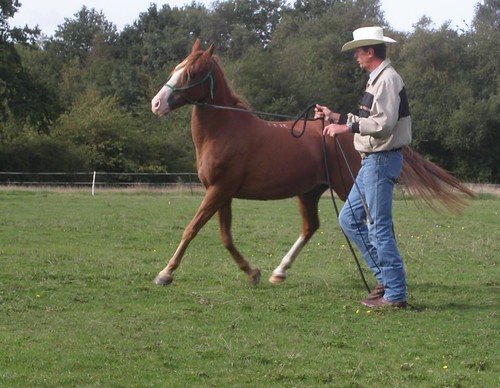
Steve with a slightly agitated Fin
Although he was a lot calmer, Fin was still full of energy and really needing to be able to move his feet so Karen ended up having to keep moving for most of the day. Steve also talked through some of the techniques he uses to help horses that have become strongly pair-bonded, which involve bringing both horses into the same schooling area and making it more uncomfortable when they are together than when they are apart. The same technique can be used at any time when there is a place where the horse wants to be and keeps homing to when they are supposed to be going somewhere else.
One of the things that Steve used a lot in asking the horses to move around with him, was using the lead rope as an indirect rein to ask the outside hind foot to step out by asking just as the foot was coming off the ground. This works in a very similar way to pushing the nearside hind foot away to ask for the hindquarters to disengage but it is less likely to encourage a horse to go forward more because there is no pushing involved so it makes a much better way of stopping them, albeit one requiring some practice.
As Steve went around each horse and handler, different issues came up, but one that was quite common was that they were tending to drop their shoulders in, particularly in trot. The shoulder was tending to collapse towards the centre of the circle. Another theme that emerged from the course was that of noticing patterns- patterns in how horses work and patterns in how we work with them. Everyone falls into patterns of doing things and unless you are paying close attention you can become good at following your own patterns rather than being good at the skill you are trying to acquire. To break out of patterns you first need to know they are there, then you can try and slow them down and start to break them up.
When the horses were falling in on the circle, Steve was working to push the shoulder out as it started to come in by turning it into a half-pass movement- in a sideways or diagonal movement it is very difficult to lean either way so it helps the horse to find it's balance and continue.

Steve pushes Lottie's shoulder away in order to balance her movement.
Another interesting detail that most people were suffering from was that they were setting themselves up to fail- by starting their own movements before they had their horse attentive and ready to move, they were putting themselves in a position where the horse would probably start moving eventually but it would not really be with them and they would have to work much harder to get it with them. Some horses, who don't really know how to be with a person, will need a human to be working to be with them before they understand what the feel they are looking for is - one of Steve's regular lines over the weekend was "be with the horse so the horse can be with you." This particularly applied to a pair of very handsome young warmbloods who had sort of fallen into the lap of one of the participants on the course. The change in them over the four days was beautiful to see, although their handler certainly still had her hands full when she left.
The concept of being with is not easy to explain, but I suppose it just means that the horse is exactly reflecting the human, speeding up and slowing down when they do, stopping when they do and attentive to their cues to change direction and so on. The aim is to get your relationship to a place where when you pick up the rope or the rein the horse is with you and ready for anything you're going to ask.
Steve mentioned a quote from Buck Brannaman with regard to this: "When you walk off without your horse, you teach him not to come with you."
Working with Joe, who still inclines towards anxiety although he is much improved over the last year or two, and had bolted around the field once already that morning, Steve talked about introvertion and how some horses tend to internalise their feelings so that when you put pressure on them they may not noticeably respond but they are storing up that pressure on the inside until the horse reaches the point where they have to leave and suddenly they are bolting without having shown more warning than a worry triangle above the eye or a tightness around the lips.
One approach to help work with a horse like this is to reset the pressure levels, so that rather than going ask-> ASK -> tell -> TELL -> TELL WITH LOADS OF EXTRA ENERGY if you aren't getting the results, you might go ask->ASK->tell and then have a short break if you haven't got the result you want and start again ask->ASK->tell and again give the horse a moment's thinking space. As long as your tell is effective it isn't going to want to get there more than a couple of times and it is likely to offer something on the ask pretty soon. It certainly seemed to work well for Joe.
Another associated problem that Joe suffers from is that because he is perpetually thinking of leaving and looking for an escape route, he will tend to want to keep his nose out when he is working on a circle so that he is always ready to leave. The solution was to very gently ask his nose into the circle as he moved, allowing him to have a break when he got it right. This is quite difficult with Joe because he has a lot of willingness to just stop and turn to face you if you ask too strongly or too much in time with his offside hind leg (for the reasons I mentioned earlier) there is a lot of subtlety in the accurate use of the lead rope. Very often you will get what you ask for rather than what you want and it may not be at all obvious to you that it is what you were asking for.
When you do have a horse that is afraid you need to be able to work through that fear with them once you start getting into it- if you give up half way through the process you are going to end up teaching the horse to be afraid and that's unlikely to work out very well for either of you in the long run.
At all times with the horse ask yourself the question "What am I teaching them?"
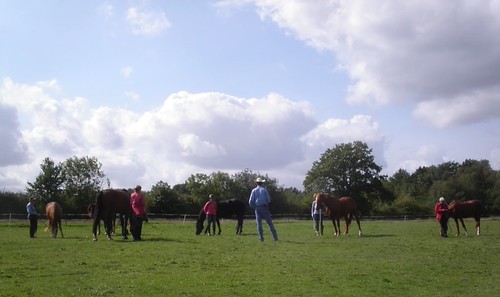
Steve talking to the handlers at the end of the first morning
The afternoon began by working on getting the horses to back up lightly. Again this was all about working with their balance and the first step was the simple task of getting some soft and light head yields.
The first thing everyone needed to ask their horses for was a willing lowering of the head. The ask for this was just downward pressure at the knot of the rope, gripping it with the thumb downwards, maintained until the horse was willing to give their head. In a couple of cases where the horse was just bracing and locking up ( when the neck is braced you are not going to be able to find lightness in the rest of the horse ) Steve started rocking the head slightly, asking for any softening at all and releasing when he got it. Once the horses realised that they found release by yeilding they were much quicker to start offering to lower their heads. The key to this is spotting the try when it happens because if you miss it, you are going to teach the horse that trying to do that doesn't work and you're going to have to keep working a lot longer before they offer again.
Once they could lower their heads so that the poll was at around withers height or a little below, the next step was to ask for a bit of flexion at the poll. This was done from the same grip as the head lowering exercise but rather than asking the head down, it involved turning the hand up towards the chin of the horse to ask them to come in a bit.
The important thing about this work is that the horse needs to be carrying it's own head, not relying on you to support it.
From lowering and flexing the head the next step was to ask for a backward movement with it, which needed to be soft and flexible from start to finish. With the head lowered and using the flex at the poll, the feeling to look for was of lifting the shoulders as needed. Lightness in the shoulders means they are under more control and more of the weight is being supported through the quarters. If you teach a horse to back up with it's head forward you will have a very hard time changing things so it can back up softly.

Buchenar was very unwilling to lower his head and back up...

...after a bit of work he is much softer and more willing to listen, notice the difference in head carriage and how attentive he is to Steve's position
When everyone was backing up successfully, Steve moved on to backing in a circle. This involves backing up as usual, but asking the horse to tip it's head to the outside and then back up to the inside, so if you were stood with the horse's head on your left you would be asking it to tip it's head away from you and then leading it on a circle to your right. When you have the correct soft feel in the back up you can then ask the horse to turn on it's haunches and move forward with you as a reward.
In order to back up on a circle the horse has to be soft right through it's body, at which point it is offering you control of it's whole body. Mentally that is a very big deal for the horse, so if they are willing to do that for you, you know you are getting something right in your relationship.
One lesson that we saw in several horses was the distinction between softness and weakness- a horse will try to pull on you and try to resist the pressure you are putting on them if they can and you are likely to have to go through some resistence before the horse will work softly with you. The important thing is that your instructions are clear and consistent- the point came up several times that it is easy to ambush your horse, offering unclear instructions and then really putting the pressure on when they don't know what to do. It is important that all your instructions are clear so that you only ever have to tell the horse when it has ignored a clear ask. If you are in a place where you always have to tell the horse, there is something wrong with how you are asking.
Another problem Namara, a charming chestnut Arabian mare, was having with the backup was that she was trying to stay shoulder heavy and drag her feet rather than picking them up properly- this suggests that the horse isn't really engaged with the task of backing up and so Steve worked for softness by doing lots of transitions between backing up and turning and backing up and turning and asked her to pick up her feet more by treading on her toes when she didn't. That seemed to get her mind on going backwards fairly quickly.
After this work, everyone got on their horses and they started some riding work, beginning with work on the indirect rein, bending the horse to a stop and focussing on the thought that less is more. Although Steve trained for many years with Pat Parelli and his techniques derive partly from that experience, the approach he teaches is one where the groundwork and the riding are very closely allied, asking for the same movements from the horse off the same cues, to make things as easy as possible for them. Steve will ride on a very loose rein, only taking it up when he needs it and expecting that the horse will pick up it's feet as he picks up his reins. The outcome is a lightness in his riding that makes it look as though he weighs nothing to the horse, although at 6'6" with legs that dangle past the barrel of most of the horses on the clinic, they clearly do know he is there. Discussing how the shoulders and reins are connected, he described how on his horse he found himself muddying the waters as far as it was concerned by asking for shoulder in with his leg when it was easily able to do it just off the rein.
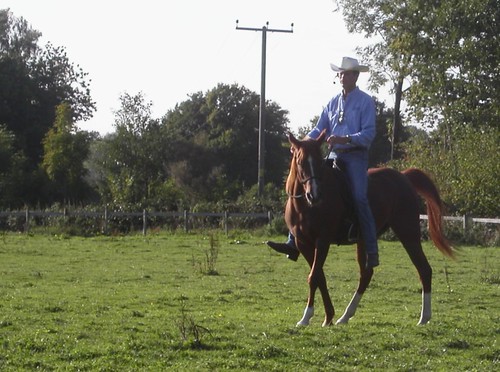
Steve riding Namara
The riders worked on making sure that the movements of the horse came from behind, especially when asking them to bend to a stop ( Steve teaches the one-rein stop as the safest way of stopping a horse that is determined to keep going ) and that when they are being asked to bend to a stop it is important to feel that the horse is bending and then stopping, rather than that they are stopping and then bending afterwards.
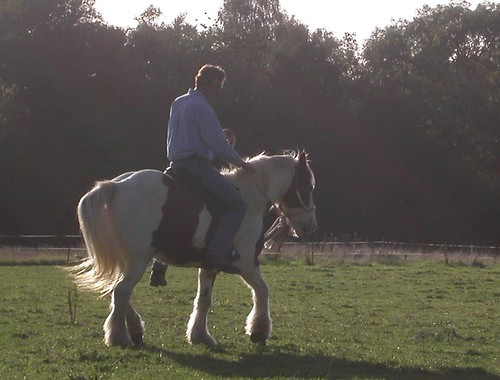

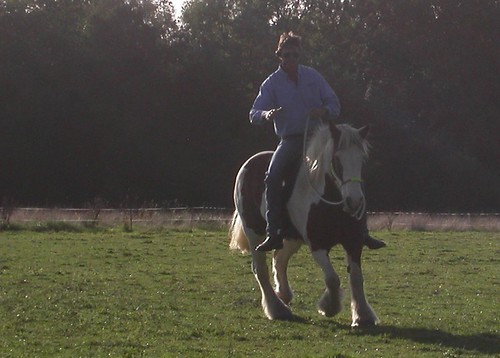
Steve asking Joe to yeild his hindquarters.
The day began with groundwork again and pretty much everyone (well, all the horses at any rate) seemed to be getting their shoulders stuck, one way and another- it was very interesting to see the solutions to the same problem varying between different horses. Horses become heavy on the shoulder because they don't usually have to be light there - grazing and wandering about the field is all stuff you can do while leaning on your forehand, in the wild it's only when they are playing, fighting or showing off that you will see a horse really lighten it's shoulders and work from behind.
Other things I noticed about Steve's way of working during the morning were that he very rarely has a straight rope between him and the horse- pretty much the only time you will see that is when the horse is pulling away. That means that when he does take the slack out of the rope it is very clear to the horse that he means it and that he isn't permenantly nagging at the horse with a feel on the rope that doesn't actually signify anything. He also does most of his work a fair distance from the horse- certainly a couple of metres between his feet and those of the horse is normal. This makes it much easier for him to see what is going with the whole horse and gives him space so the horse can see his movements- when he's moving into the horse's space to get it to move it's shoulders he takes the attitude that "when I get to where your shoulder is you had better not be there." One thing that I noticed he is doing differently over past clinics is that when he needs to physically move a horse that has ignored his asks he is now as likely to bump it out the way with his knees or hips as he is to slap it with the end of the lead rope. When I first saw Steve work I was a bit surprised by how strong he is with the horses but he is very careful to give clear signals about everything he is going to do- if the horse hasn't moved it has plenty of warning that it should have. It is very unusual that he ever needs to tell a horse to do something twice. The next time it will go when he asks. One point he made was that you need to really look for the asks when watching him work because they can be very subtle whereas the tells are much more obvious and it would be easy to think that they are all that is going on.
He is also adept at judging what the horse needs- when a horse doesn't know what is being asked of it, he is very careful to do everything he can to help the horse get it right and then reward the right thing as soon as it is visible. Once again the principle of "be with the horse so that the horse can be with you" comes into play.
There was a lot of work done on intention and making sure the horse cares enough to do what you ask. There is no such thing as a lazy horse, but it is natural for a horse to believe it may need to escape from a predator later so it shouldn't have to expend too much energy now just in case. You need to make doing what you ask important enough to the horse that it is prepared to use some of that energy working with you rather than saving it for later.
Before lunch we had a very interesting discussion on tying horses up where Steve was explaining that he always ties his horses up directly to the loop because if the horse has learned to tie up it can tie up safely anywhere, but that most people don't teach their horse to tie up like he does. His approach is that you need to teach a horse to give to pressure, so that pulling on a tied rope is not on the cards for them and that you need to teach them to be brave enough to never want to pull back when they are tied up. It is all too easy to teach a horse not to move it's feet when it is tied up and then find that something happens that means it needs to move it's feet while it is tied up and it can't.
Another afternoon of ridden work, but the groundwork with the horses saddled up brought all sorts of interesting things to the surface and happily I managed to get pictures of some of it!
Lottie, a very spectacular black mare, had been having problems with her canter transitions which Steve suggested were because she wasn't well balanced as she went into canter. When horses are badly balanced they are likely to be quite worried about transitions to faster paces and work really hard to try and recover their balance. One of the major reasons horses buck is to try and recover their balance - if their legs are not fully under them a buck is a very good way for the horse to get themselves up off the ground enough that they can get their legs back where they are supposed to be. That was a bit of a light bulb moment for me, although I'm happy to say I've not had to deal with a lot of bucking yet.

Lottie working- see if you can spot where she is out of balance...

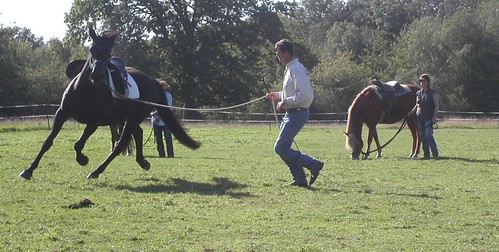
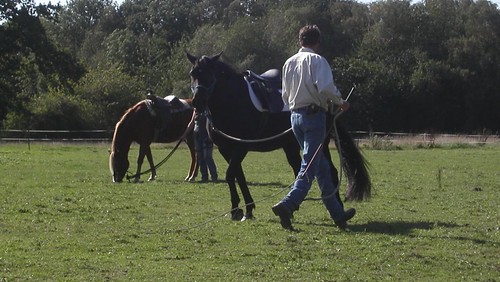
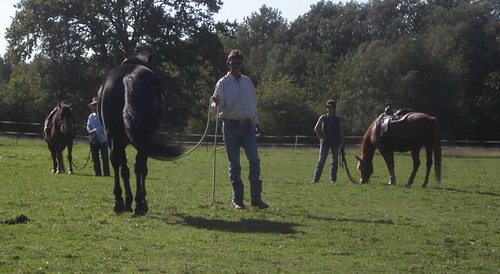
After a while she is starting to get more level and mellow out a bit.
Lottie is very sensitive and it didn't need nearly as much pressure to pick up her paces- if she had been faced with the level of energy that some of the other horses needed she would have pretty much been in orbit. Come to think of it, she would have been quite well camouflaged there so it would have been very tricky to get her back.
As it was it took a while to bring her down from the high energy work she had been doing- Steve used figures of eight to settle her down, asking her forward ( a nervous horse will be happier moving it's feet, if you try and force it to stand still you may get some unexpected results) around the outside and then offering a stop at the middle of the "8". It took a lot of trips around the shape before Lottie felt calm enough to stop.
Joe was being obstinate with his shoulders and also tending to collapse them and fall out of balance as he picked up his paces but he has his own special solution to situations that he finds frightening:

It begins with rage...

...continues through planning...
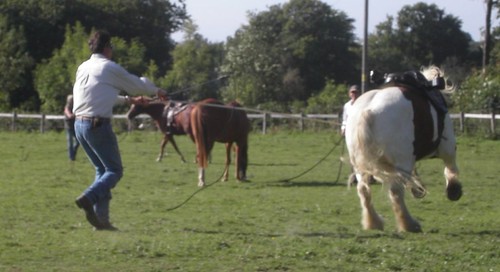
...and ends with rampage.
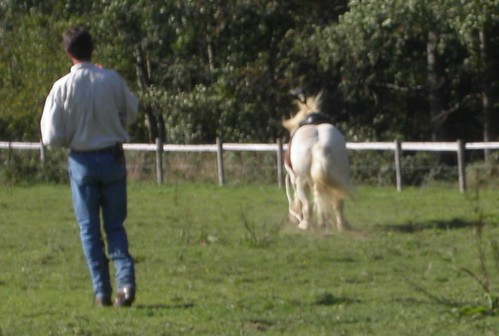
Once we had caught Joe again Steve explained that sometimes the horse will get the angle and have the strength and that you might as well let go because they're going to go regardless. Best to let that happen in a safe environment. Counter-intuitively he suggested that with a horse that tends to do that you may be better off on their back - assuming you know the environment is safe - that way you're going to end up in the same place as them. In a situation like he has back in Australia he would want to ride Joe through a couple of his bolts and just ask him to keep going when he wanted to stop. Steve reckoned that Joe would fairly quickly have second thoughts about wanting to go hurrying off anywhere at that point.
The riders got riding next, focussing particularly on the idea of riding the legs. There has been a lot written and said about footfall and it is undeniably critically important. Steve discussed how, like many horsepeople down the years, he had worked for ages on listening for when each leg was rising and falling, using a rope around a leg to feel when that one was moving and generally studying the topic in question. He mentioned what a disappointment it was when he realised that there isn't really any great mystery there, you can pick it all up from the swing of the barrel. It will swing away to give the hind leg space to move forwards, so in walk you will feel the barrel swing to the left as the right hind leg steps forward and there will be a tiny pause at the end of the swing as the right foreleg starts it's step forward. A bit like looking everywhere for your sunglasses and then realising that you have hooked them into the collar of your t-shirt.
Once again there was a lot of focus on keeping the reins light- if you are heavy on the reins all you will ever teach a horse is to be heavy on the reins and once the horse is allowed to be heavy on your hands that weight will have to go somewhere, which will be through you back to the horse, confusing matters further. A corollary of this is that if you are riding a horse and they stumble you need to keep looking up- if you look down you're going to push your balance a little forward, which will certainly not help them, and if you try to haul them up on the reins you're just going to put all that weight straight back on the forehand and probably make matters worse. The best person to sort out that kind of situation really is your horse- it's their legs and they know what they are doing. Also, if you're looking up and keeping your weight back and the horse does go down, you've got a much better chance of getting clear safely than if you're leaning forward.
In the evening Steve did a bit of a demonstration for us with Isis, a beautiful rescued arab mare who could teach Sabatier a few things about sharpness. They started doing some liberty work in a round pen, but Isis was still in sight of her fieldmate and really wanted to be back with him, to the point that she dispelled some myths about arabs not being able to jump and flew out of the round pen. Steve and Irena (Steve's wife) caught her and brought her back and as she seemed a lot happier on a line - the halter gave her a lot of security - than she had been at liberty he went through some of the process he uses starting a horse. This involved a lot of climbing half way over her and waving his arms around, making sure that she is ready for anything he might do- as he pointed out, it's all great to be able to get on a horse quickly, but if you can only whisper and the horse will leave like a rocket the first time someone catches it with their foot when they're mounting, it's not going to work out well for anyone. He ended up riding her gently in the last beams of the setting sun, his legs dangling most of the way to the ground. Starting horses may be Steve's day job, but it's a whole lot more interesting to watch than my day job...
The morning began with a discussion of position and how your position relates to that of the horse, working behind the drive line - for anyone unfamiliar with the term, this goes roughly down the horse's shoulder and asks that happen behind that are driving the horse forward whereas those ahead of it are more likely to push the horse backwards.
We then began our practical work with an absolutely fascinating exercise that I would recommend to anyone who regularly deals with horses. It involved splitting into groups of three. Two people stood one in front of the other, the one behind with their hands on the shoulders of the person in front, the other with their hands together in front of them and a string around their wrists. They represent the horse and the other person takes the end of the string and acts as the handler, trying to get the "horse" to do what they want. For the exercise to work, the horse needs to be well behaved; by which I mean that it needs to be trying to do what the handler is asking of it. The outcome of the exercise is hilarity, but deeply informative hilarity. I found that as a handler I was actually pulling on the string even when I thought I had it soft and relaxed. At the end of the exercise almost everyone found that the "horse" hadn't quite been doing what they thought it would but what was especially interesting was how many people had found that a human horse had reacted to them in almost exactly the same way that their real horse does. It was also interesting to notice how light one could be on the lead and still be easily felt.
The real horses then came out to do some liberty work in the round pen we had set up for the demo. The exercise that everyone was working on was moving the horses in a figure of eight, driving them around away from the handler at the corners rather than hooking them on and leading them from in front, which is a common feature of most round-pen exercises. If you are driving the horse you need them to be a lot more attentive if they are going to stay with you- if they want to leave they can. The principle was continuing with the use of the indirect rein but without actually having a rein of any kind.
It was interesting to note that as the exercise began working for people they were working at a distance about equivalent to half the width of the round pen. Once the horse is paying attention it is amazing how sensitive they are.
Ultimately you should be able to do the liberty exercises without a pen.
While people took turns with the pen, the other people were working on an on-line variant of the exercise where they worked to get the horse moving for them while stood level with their hindquarters, giving a "leading from behind" kind of feel.
Joe was using his ability to back up and to turn neatly on his quarters as an evasion at this point, making life very hard for my beloved as she tried to get him to turn and move forward with her and he stomped resolutely off backwards. Steve showed that part of the problem was the way that Lou was asking Joe for things- he was doing what he was being asked for but he wasn't doing what she wanted him to. When she was asking for the right thing she needed to be prepared to keep pushing for it until she got it. One of the great things about having an expert trainer on hand is that they can give you the confidence to know you are doing the right thing and that you just need to keep doing it until pony actually pays attention. The corollary of this is that in some circumstances you need to be prepared to change what the right thing is if the horse isn't doing what you had planned but was offering something worth rewarding.
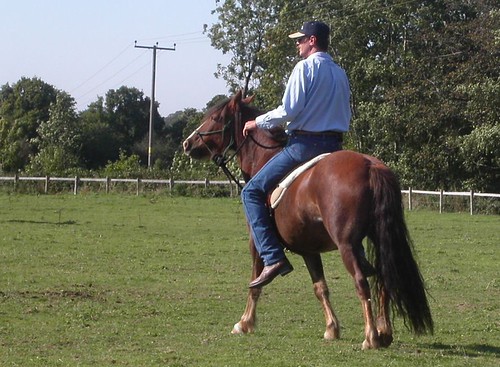
Steve sits on TP (short for "Tiny Pony") who is utterly adorable but possibly a little small for him.
The first ridden exercise was a two person one, one on each end of about 30' of rope. One person stayed still, while the other rode a semi-circle around them, keeping the rope straight the whole time, turned round and rode back to the starting point. The turn would involve the horse having to pass it's head under the rope, but by this point everyone was fairly happy to allow ropes around them without panicking. The value of this exercise is partly that doing it correctly requires the rider to describe a perfect circle without falling in or falling out. When Steve was demonstrating the exercise with one horse who was trying to fall in a little he ended up taking off his hat and tapping it gently on the horse's shoulder to put a bit of pressure there that the horse will want to move away from. He also described keeping a bit of a block on the nose so that the energy that goes into the shoulder doesn't come straight out of the nose.
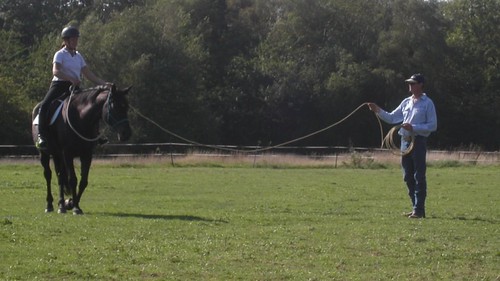
Lottie working at the end of the long rope.
He moved on to demonstrating a bit more about riding and intention, sitting on Namara and showing how if he just pointed to one side she would look in that direction, as he picked up his energy a little she would get ready to move off.
The next exercise was following on from Wednesday's groundwork, aiming to get a circular backup from the saddle. When this works out well it looks a lot like a three point turn in a car, backing around and then bringing the front across to turn it into a forward movement. When the horse remains braced, the rider needs to keep them backing, allowing the forward movement as a release when they begin to move lightly.
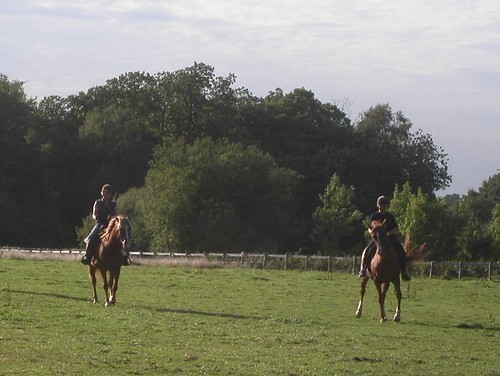
An activity both horses and riders seemed to really enjoy was a paired exercise where both riders, a few metres apart, tried to move in perfect symetry. The trick being that each rider needed to be watching their partner's horse and controlling their own to match it. This was brilliant to watch and the horses seemed to love it.
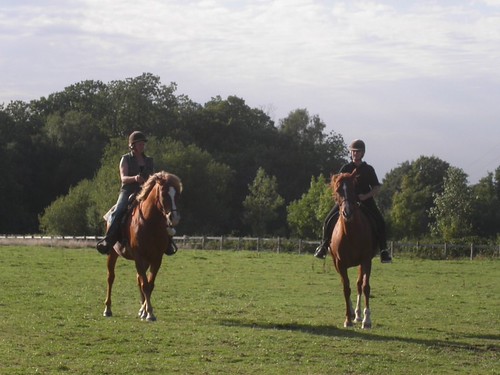
Havoc and Namara playing the mirror game.
The final exercise of the day was back on the ground and it was based on moving individual feet. Steve asked Lynn, Namara's owner, to move only Namara's left hind foot, which she managed to do after a bit of working with her balance and position. They then moved on to an even more subtle exercise, asking the horse to rock it's balance back and forward (without moving it's feet) from a feel on the head collar. Although this is a small thing to ask for it is very important- to me it's almost like the atom from which the other work of the week was built, the smallest possible unit of balance control. If your horse will offer you that, it is going to be ready to listen to whatever you ask for next and to act on it.
We finished the day with a quote from Philip Nye, one of the horsemen that Steve holds in the highest regard, which I didn't actually manage to write down with any accuracy so I will paraphrase : "Most of you have no idea what is possible with the horses you are riding."
We had a wonderful week for weather, considering we were in England in late September, but our luck couldn't hold for the whole week and sure enough Friday night it poured and although it had stopped by the time we got up and got started we were under a leaden sky that suggested we may not stay dry indefinitely.
We began by going through the list of objectives from Tuesday and exploring whether any of them had been attained. Most people felt they had but that they had also found whole new realms of things they wanted to achieve that they hadn't even realised they wanted to achieve. The important thing on the journey forward is observation- recognising the first steps to the goal, noticing the changes as they happen because it is easy to slip into patterns if you're not careful and keep asking questions: What do I see? Am I getting closer? What am I teaching my horse?
Steve pointed out that what we need to be to our horses is a leader and that leaders are not scary people. If your horse is afraid of you, you are not a leader.
The morning's work was long-reining, Silversand-style, using a 22 foot line looped from the headcollar to the headcollar. There was a bit of rope handling instruction to start with because long ropes can be dangerous things and injuries from badly handled coils are easily achieved. Steve's years as a western rider mean he is pretty handy with a rope - he tends to do the same work on a 60 foot line but he has his students start with something a little easier to work with.
The focus of this work was on feel and indirect rein work again, as well as getting the horse working in arcs and figures of eight to help them become more accustomed to seeing their human changing eyes. A significant point that people sometimes miss is that things that happen in the right eye are different to things that happen in the left eye as far as the horse is concerned so you need to make sure you do everything from both sides.

Working on the 22' rein.
Unfortunately, at this point the weather decided to follow the old adage that "if it's reining; it's raining," and really set in. We struggled on bravely to an early lunch break, but my notes pretty much peter out at this point as my notebook was getting comprehensively wet.
After lunch and a while huddling at the little rustic ranch-house on the yard watching video of Steve and his students starting colts and working with their own horses in beautiful, sun-drenched, Australia (I think quite a few of us were keen to emigrate on the spot) the rain began to lessen and we got the horses back out to work. Actually, the horses had been out the whole time, so they were kind of damp, but they didn't seem to mind. Probably because they hadn't just watched videos of beautiful sun-drenched Australia.
The afternoon's riding was a little slower because the ground was wet and slippery but featured some very interesting exercises. One of these had Steve going round each person in turn and asking them for a set number of steps forward- can you get your horse to take five steps towards me? Then two steps back? Most people could get close, but only Louise and Joe and our excellent host Jan with her pony Havoc were absolutely on the mark. A useful general exercise to take from this might be to think up a set of numbers and then try to get them- "can I get 9 steps of walk, then 6 of trot then 4 of walk then halt and back up 2?"
This also showed up how straight the horses could move- Steve pointed out that another aspect of the unbalanced shoulder thing would be the horse stepping slightly to the outside as it set off, giving a bit of lateral sway. He suggested that if his horse was doing that, he would back it up and ask it to start again. If necessary make the instruction clearer, but don't settle for less than exactly what you want.
By this time the sun was out again and everyone was off working on things they wanted to get on with. Steve remarked to those of us spectating that he was happy to say he felt a little redundant at that point as everyone had found a place where they knew what they were going for and they were finding how to get them. Most of the horses had a lightness and balance to their movement that had been lacking on Tuesday morning and their riders had a confidence and joy in their horses and their relationship that was beautiful to see.
It was an amazing week and I have learned a huge amount from watching, part of which is that I'm determined I'll be riding next year. The people on the clinic were brilliant company and we had some fantastic evenings sitting around the bonfire and setting the world to rights or discussing the curious foibles of the horses we belong to. As spectators we were really included - at the beginning and end of each day Steve went around everyone, handlers and audience, asking what we had learned that day and generally helping to spark off discussion of what we were doing. The only problem we have is that with all this inspiration the nights are closing in and the time we will have to spend with our horses each day is reducing. Our teacher is off back to beautiful, sun-drenched, Australia to follow five months of non-stop teaching clinics with a winter of his day job, playing with horses in the sun.
I thoroughly enjoyed myself and I learned a huge amount, but what I've written here is only a fragment of that, but if I've learned anything about horsemanship or any other learned activity, it's that you can only see and understand things that you are ready for. Just as you can't build the ground floor without the foundation or the roof without the ground floor, the things that I notice and are important to me may be different to the things you would notice or that would be significant to you. Each step on the journey changes the view and changes your understanding of the steps you've already taken and the ones that are still ahead of you, and that's a very good thing as long as you remember that being good at this step is a better route to the next step than trying to rush ahead and find it for yourself. When you're ready for it, it will find you.

TP, winner of the "pony everyone wanted to steal and take home with them" award.
You can find more about Silversand and about Steve's work at www.silversand.com.au.
I'm going to begin by putting this in approximate order of things that happened but moving ideas around a bit if there are places where they seem to fit. There is a lot of information here (it's based on what I can recall and the 25 pages of notes I took over the week) and it may not order very well but I'll try to keep things readable and interesting. There are a few pictures around the place too, where I have good ones.
Tuesday Morning
As usual, Steve set out by going around everyone- spectators and participants alike- and finding out what their goals were for the course, the list included working on transitions, softness, trust, listening to the horse and having fun. At the cross-roads of these different topics was one that became the theme of the weekend: Balance. Most people's horses are not well balanced. Most people have never ridden a horse that is properly in balance with itself, so they have no idea what feel they are looking for or what their own horse is capable of. Over the course of the weekend Steve was able to help all the riders to find a bit more balance and lightness in their horses and open new avenues for them to explore while they worked on it.
It was quickly time to get the horses out and just start getting them warmed up, to see how they were getting on and what presented itself initially in the relationship between horse and handler. It immediately became fairly clear that Fin, a beautiful but exceptionally emotional little pony who has been restored from a total wreck by the skill and patience of his owner Karen (former owner of our Joe), was not dealing well with the new situation and couldn't stop moving or be away from his fieldmate.
Steve was able to get his attention and bring him back to a place where he was able to listen - very often when he sees a problem with a horse on a clinic, Steve will help the horse work it through with him so that he can deal with any unexpected or explosive reactions that might be dangerous in the hands of a less experienced handler.
Steve with a slightly agitated Fin
Although he was a lot calmer, Fin was still full of energy and really needing to be able to move his feet so Karen ended up having to keep moving for most of the day. Steve also talked through some of the techniques he uses to help horses that have become strongly pair-bonded, which involve bringing both horses into the same schooling area and making it more uncomfortable when they are together than when they are apart. The same technique can be used at any time when there is a place where the horse wants to be and keeps homing to when they are supposed to be going somewhere else.
One of the things that Steve used a lot in asking the horses to move around with him, was using the lead rope as an indirect rein to ask the outside hind foot to step out by asking just as the foot was coming off the ground. This works in a very similar way to pushing the nearside hind foot away to ask for the hindquarters to disengage but it is less likely to encourage a horse to go forward more because there is no pushing involved so it makes a much better way of stopping them, albeit one requiring some practice.
As Steve went around each horse and handler, different issues came up, but one that was quite common was that they were tending to drop their shoulders in, particularly in trot. The shoulder was tending to collapse towards the centre of the circle. Another theme that emerged from the course was that of noticing patterns- patterns in how horses work and patterns in how we work with them. Everyone falls into patterns of doing things and unless you are paying close attention you can become good at following your own patterns rather than being good at the skill you are trying to acquire. To break out of patterns you first need to know they are there, then you can try and slow them down and start to break them up.
When the horses were falling in on the circle, Steve was working to push the shoulder out as it started to come in by turning it into a half-pass movement- in a sideways or diagonal movement it is very difficult to lean either way so it helps the horse to find it's balance and continue.
Steve pushes Lottie's shoulder away in order to balance her movement.
Another interesting detail that most people were suffering from was that they were setting themselves up to fail- by starting their own movements before they had their horse attentive and ready to move, they were putting themselves in a position where the horse would probably start moving eventually but it would not really be with them and they would have to work much harder to get it with them. Some horses, who don't really know how to be with a person, will need a human to be working to be with them before they understand what the feel they are looking for is - one of Steve's regular lines over the weekend was "be with the horse so the horse can be with you." This particularly applied to a pair of very handsome young warmbloods who had sort of fallen into the lap of one of the participants on the course. The change in them over the four days was beautiful to see, although their handler certainly still had her hands full when she left.
The concept of being with is not easy to explain, but I suppose it just means that the horse is exactly reflecting the human, speeding up and slowing down when they do, stopping when they do and attentive to their cues to change direction and so on. The aim is to get your relationship to a place where when you pick up the rope or the rein the horse is with you and ready for anything you're going to ask.
Steve mentioned a quote from Buck Brannaman with regard to this: "When you walk off without your horse, you teach him not to come with you."
Working with Joe, who still inclines towards anxiety although he is much improved over the last year or two, and had bolted around the field once already that morning, Steve talked about introvertion and how some horses tend to internalise their feelings so that when you put pressure on them they may not noticeably respond but they are storing up that pressure on the inside until the horse reaches the point where they have to leave and suddenly they are bolting without having shown more warning than a worry triangle above the eye or a tightness around the lips.
One approach to help work with a horse like this is to reset the pressure levels, so that rather than going ask-> ASK -> tell -> TELL -> TELL WITH LOADS OF EXTRA ENERGY if you aren't getting the results, you might go ask->ASK->tell and then have a short break if you haven't got the result you want and start again ask->ASK->tell and again give the horse a moment's thinking space. As long as your tell is effective it isn't going to want to get there more than a couple of times and it is likely to offer something on the ask pretty soon. It certainly seemed to work well for Joe.
Another associated problem that Joe suffers from is that because he is perpetually thinking of leaving and looking for an escape route, he will tend to want to keep his nose out when he is working on a circle so that he is always ready to leave. The solution was to very gently ask his nose into the circle as he moved, allowing him to have a break when he got it right. This is quite difficult with Joe because he has a lot of willingness to just stop and turn to face you if you ask too strongly or too much in time with his offside hind leg (for the reasons I mentioned earlier) there is a lot of subtlety in the accurate use of the lead rope. Very often you will get what you ask for rather than what you want and it may not be at all obvious to you that it is what you were asking for.
When you do have a horse that is afraid you need to be able to work through that fear with them once you start getting into it- if you give up half way through the process you are going to end up teaching the horse to be afraid and that's unlikely to work out very well for either of you in the long run.
At all times with the horse ask yourself the question "What am I teaching them?"
Steve talking to the handlers at the end of the first morning
Tuesday Afternoon
The afternoon began by working on getting the horses to back up lightly. Again this was all about working with their balance and the first step was the simple task of getting some soft and light head yields.
The first thing everyone needed to ask their horses for was a willing lowering of the head. The ask for this was just downward pressure at the knot of the rope, gripping it with the thumb downwards, maintained until the horse was willing to give their head. In a couple of cases where the horse was just bracing and locking up ( when the neck is braced you are not going to be able to find lightness in the rest of the horse ) Steve started rocking the head slightly, asking for any softening at all and releasing when he got it. Once the horses realised that they found release by yeilding they were much quicker to start offering to lower their heads. The key to this is spotting the try when it happens because if you miss it, you are going to teach the horse that trying to do that doesn't work and you're going to have to keep working a lot longer before they offer again.
Once they could lower their heads so that the poll was at around withers height or a little below, the next step was to ask for a bit of flexion at the poll. This was done from the same grip as the head lowering exercise but rather than asking the head down, it involved turning the hand up towards the chin of the horse to ask them to come in a bit.
The important thing about this work is that the horse needs to be carrying it's own head, not relying on you to support it.
From lowering and flexing the head the next step was to ask for a backward movement with it, which needed to be soft and flexible from start to finish. With the head lowered and using the flex at the poll, the feeling to look for was of lifting the shoulders as needed. Lightness in the shoulders means they are under more control and more of the weight is being supported through the quarters. If you teach a horse to back up with it's head forward you will have a very hard time changing things so it can back up softly.
Buchenar was very unwilling to lower his head and back up...
...after a bit of work he is much softer and more willing to listen, notice the difference in head carriage and how attentive he is to Steve's position
When everyone was backing up successfully, Steve moved on to backing in a circle. This involves backing up as usual, but asking the horse to tip it's head to the outside and then back up to the inside, so if you were stood with the horse's head on your left you would be asking it to tip it's head away from you and then leading it on a circle to your right. When you have the correct soft feel in the back up you can then ask the horse to turn on it's haunches and move forward with you as a reward.
In order to back up on a circle the horse has to be soft right through it's body, at which point it is offering you control of it's whole body. Mentally that is a very big deal for the horse, so if they are willing to do that for you, you know you are getting something right in your relationship.
One lesson that we saw in several horses was the distinction between softness and weakness- a horse will try to pull on you and try to resist the pressure you are putting on them if they can and you are likely to have to go through some resistence before the horse will work softly with you. The important thing is that your instructions are clear and consistent- the point came up several times that it is easy to ambush your horse, offering unclear instructions and then really putting the pressure on when they don't know what to do. It is important that all your instructions are clear so that you only ever have to tell the horse when it has ignored a clear ask. If you are in a place where you always have to tell the horse, there is something wrong with how you are asking.
Another problem Namara, a charming chestnut Arabian mare, was having with the backup was that she was trying to stay shoulder heavy and drag her feet rather than picking them up properly- this suggests that the horse isn't really engaged with the task of backing up and so Steve worked for softness by doing lots of transitions between backing up and turning and backing up and turning and asked her to pick up her feet more by treading on her toes when she didn't. That seemed to get her mind on going backwards fairly quickly.
After this work, everyone got on their horses and they started some riding work, beginning with work on the indirect rein, bending the horse to a stop and focussing on the thought that less is more. Although Steve trained for many years with Pat Parelli and his techniques derive partly from that experience, the approach he teaches is one where the groundwork and the riding are very closely allied, asking for the same movements from the horse off the same cues, to make things as easy as possible for them. Steve will ride on a very loose rein, only taking it up when he needs it and expecting that the horse will pick up it's feet as he picks up his reins. The outcome is a lightness in his riding that makes it look as though he weighs nothing to the horse, although at 6'6" with legs that dangle past the barrel of most of the horses on the clinic, they clearly do know he is there. Discussing how the shoulders and reins are connected, he described how on his horse he found himself muddying the waters as far as it was concerned by asking for shoulder in with his leg when it was easily able to do it just off the rein.
Steve riding Namara
The riders worked on making sure that the movements of the horse came from behind, especially when asking them to bend to a stop ( Steve teaches the one-rein stop as the safest way of stopping a horse that is determined to keep going ) and that when they are being asked to bend to a stop it is important to feel that the horse is bending and then stopping, rather than that they are stopping and then bending afterwards.
Steve asking Joe to yeild his hindquarters.
Wednesday Morning
The day began with groundwork again and pretty much everyone (well, all the horses at any rate) seemed to be getting their shoulders stuck, one way and another- it was very interesting to see the solutions to the same problem varying between different horses. Horses become heavy on the shoulder because they don't usually have to be light there - grazing and wandering about the field is all stuff you can do while leaning on your forehand, in the wild it's only when they are playing, fighting or showing off that you will see a horse really lighten it's shoulders and work from behind.
Other things I noticed about Steve's way of working during the morning were that he very rarely has a straight rope between him and the horse- pretty much the only time you will see that is when the horse is pulling away. That means that when he does take the slack out of the rope it is very clear to the horse that he means it and that he isn't permenantly nagging at the horse with a feel on the rope that doesn't actually signify anything. He also does most of his work a fair distance from the horse- certainly a couple of metres between his feet and those of the horse is normal. This makes it much easier for him to see what is going with the whole horse and gives him space so the horse can see his movements- when he's moving into the horse's space to get it to move it's shoulders he takes the attitude that "when I get to where your shoulder is you had better not be there." One thing that I noticed he is doing differently over past clinics is that when he needs to physically move a horse that has ignored his asks he is now as likely to bump it out the way with his knees or hips as he is to slap it with the end of the lead rope. When I first saw Steve work I was a bit surprised by how strong he is with the horses but he is very careful to give clear signals about everything he is going to do- if the horse hasn't moved it has plenty of warning that it should have. It is very unusual that he ever needs to tell a horse to do something twice. The next time it will go when he asks. One point he made was that you need to really look for the asks when watching him work because they can be very subtle whereas the tells are much more obvious and it would be easy to think that they are all that is going on.
He is also adept at judging what the horse needs- when a horse doesn't know what is being asked of it, he is very careful to do everything he can to help the horse get it right and then reward the right thing as soon as it is visible. Once again the principle of "be with the horse so that the horse can be with you" comes into play.
There was a lot of work done on intention and making sure the horse cares enough to do what you ask. There is no such thing as a lazy horse, but it is natural for a horse to believe it may need to escape from a predator later so it shouldn't have to expend too much energy now just in case. You need to make doing what you ask important enough to the horse that it is prepared to use some of that energy working with you rather than saving it for later.
Before lunch we had a very interesting discussion on tying horses up where Steve was explaining that he always ties his horses up directly to the loop because if the horse has learned to tie up it can tie up safely anywhere, but that most people don't teach their horse to tie up like he does. His approach is that you need to teach a horse to give to pressure, so that pulling on a tied rope is not on the cards for them and that you need to teach them to be brave enough to never want to pull back when they are tied up. It is all too easy to teach a horse not to move it's feet when it is tied up and then find that something happens that means it needs to move it's feet while it is tied up and it can't.
Wednesday Afternoon
Another afternoon of ridden work, but the groundwork with the horses saddled up brought all sorts of interesting things to the surface and happily I managed to get pictures of some of it!
Lottie, a very spectacular black mare, had been having problems with her canter transitions which Steve suggested were because she wasn't well balanced as she went into canter. When horses are badly balanced they are likely to be quite worried about transitions to faster paces and work really hard to try and recover their balance. One of the major reasons horses buck is to try and recover their balance - if their legs are not fully under them a buck is a very good way for the horse to get themselves up off the ground enough that they can get their legs back where they are supposed to be. That was a bit of a light bulb moment for me, although I'm happy to say I've not had to deal with a lot of bucking yet.
Lottie working- see if you can spot where she is out of balance...
After a while she is starting to get more level and mellow out a bit.
Lottie is very sensitive and it didn't need nearly as much pressure to pick up her paces- if she had been faced with the level of energy that some of the other horses needed she would have pretty much been in orbit. Come to think of it, she would have been quite well camouflaged there so it would have been very tricky to get her back.
As it was it took a while to bring her down from the high energy work she had been doing- Steve used figures of eight to settle her down, asking her forward ( a nervous horse will be happier moving it's feet, if you try and force it to stand still you may get some unexpected results) around the outside and then offering a stop at the middle of the "8". It took a lot of trips around the shape before Lottie felt calm enough to stop.
Joe was being obstinate with his shoulders and also tending to collapse them and fall out of balance as he picked up his paces but he has his own special solution to situations that he finds frightening:
It begins with rage...
...continues through planning...
...and ends with rampage.
Once we had caught Joe again Steve explained that sometimes the horse will get the angle and have the strength and that you might as well let go because they're going to go regardless. Best to let that happen in a safe environment. Counter-intuitively he suggested that with a horse that tends to do that you may be better off on their back - assuming you know the environment is safe - that way you're going to end up in the same place as them. In a situation like he has back in Australia he would want to ride Joe through a couple of his bolts and just ask him to keep going when he wanted to stop. Steve reckoned that Joe would fairly quickly have second thoughts about wanting to go hurrying off anywhere at that point.
The riders got riding next, focussing particularly on the idea of riding the legs. There has been a lot written and said about footfall and it is undeniably critically important. Steve discussed how, like many horsepeople down the years, he had worked for ages on listening for when each leg was rising and falling, using a rope around a leg to feel when that one was moving and generally studying the topic in question. He mentioned what a disappointment it was when he realised that there isn't really any great mystery there, you can pick it all up from the swing of the barrel. It will swing away to give the hind leg space to move forwards, so in walk you will feel the barrel swing to the left as the right hind leg steps forward and there will be a tiny pause at the end of the swing as the right foreleg starts it's step forward. A bit like looking everywhere for your sunglasses and then realising that you have hooked them into the collar of your t-shirt.
Once again there was a lot of focus on keeping the reins light- if you are heavy on the reins all you will ever teach a horse is to be heavy on the reins and once the horse is allowed to be heavy on your hands that weight will have to go somewhere, which will be through you back to the horse, confusing matters further. A corollary of this is that if you are riding a horse and they stumble you need to keep looking up- if you look down you're going to push your balance a little forward, which will certainly not help them, and if you try to haul them up on the reins you're just going to put all that weight straight back on the forehand and probably make matters worse. The best person to sort out that kind of situation really is your horse- it's their legs and they know what they are doing. Also, if you're looking up and keeping your weight back and the horse does go down, you've got a much better chance of getting clear safely than if you're leaning forward.
In the evening Steve did a bit of a demonstration for us with Isis, a beautiful rescued arab mare who could teach Sabatier a few things about sharpness. They started doing some liberty work in a round pen, but Isis was still in sight of her fieldmate and really wanted to be back with him, to the point that she dispelled some myths about arabs not being able to jump and flew out of the round pen. Steve and Irena (Steve's wife) caught her and brought her back and as she seemed a lot happier on a line - the halter gave her a lot of security - than she had been at liberty he went through some of the process he uses starting a horse. This involved a lot of climbing half way over her and waving his arms around, making sure that she is ready for anything he might do- as he pointed out, it's all great to be able to get on a horse quickly, but if you can only whisper and the horse will leave like a rocket the first time someone catches it with their foot when they're mounting, it's not going to work out well for anyone. He ended up riding her gently in the last beams of the setting sun, his legs dangling most of the way to the ground. Starting horses may be Steve's day job, but it's a whole lot more interesting to watch than my day job...
Thursday Morning
The morning began with a discussion of position and how your position relates to that of the horse, working behind the drive line - for anyone unfamiliar with the term, this goes roughly down the horse's shoulder and asks that happen behind that are driving the horse forward whereas those ahead of it are more likely to push the horse backwards.
We then began our practical work with an absolutely fascinating exercise that I would recommend to anyone who regularly deals with horses. It involved splitting into groups of three. Two people stood one in front of the other, the one behind with their hands on the shoulders of the person in front, the other with their hands together in front of them and a string around their wrists. They represent the horse and the other person takes the end of the string and acts as the handler, trying to get the "horse" to do what they want. For the exercise to work, the horse needs to be well behaved; by which I mean that it needs to be trying to do what the handler is asking of it. The outcome of the exercise is hilarity, but deeply informative hilarity. I found that as a handler I was actually pulling on the string even when I thought I had it soft and relaxed. At the end of the exercise almost everyone found that the "horse" hadn't quite been doing what they thought it would but what was especially interesting was how many people had found that a human horse had reacted to them in almost exactly the same way that their real horse does. It was also interesting to notice how light one could be on the lead and still be easily felt.
The real horses then came out to do some liberty work in the round pen we had set up for the demo. The exercise that everyone was working on was moving the horses in a figure of eight, driving them around away from the handler at the corners rather than hooking them on and leading them from in front, which is a common feature of most round-pen exercises. If you are driving the horse you need them to be a lot more attentive if they are going to stay with you- if they want to leave they can. The principle was continuing with the use of the indirect rein but without actually having a rein of any kind.
It was interesting to note that as the exercise began working for people they were working at a distance about equivalent to half the width of the round pen. Once the horse is paying attention it is amazing how sensitive they are.
Ultimately you should be able to do the liberty exercises without a pen.
While people took turns with the pen, the other people were working on an on-line variant of the exercise where they worked to get the horse moving for them while stood level with their hindquarters, giving a "leading from behind" kind of feel.
Joe was using his ability to back up and to turn neatly on his quarters as an evasion at this point, making life very hard for my beloved as she tried to get him to turn and move forward with her and he stomped resolutely off backwards. Steve showed that part of the problem was the way that Lou was asking Joe for things- he was doing what he was being asked for but he wasn't doing what she wanted him to. When she was asking for the right thing she needed to be prepared to keep pushing for it until she got it. One of the great things about having an expert trainer on hand is that they can give you the confidence to know you are doing the right thing and that you just need to keep doing it until pony actually pays attention. The corollary of this is that in some circumstances you need to be prepared to change what the right thing is if the horse isn't doing what you had planned but was offering something worth rewarding.
Thursday PM
Steve sits on TP (short for "Tiny Pony") who is utterly adorable but possibly a little small for him.
The first ridden exercise was a two person one, one on each end of about 30' of rope. One person stayed still, while the other rode a semi-circle around them, keeping the rope straight the whole time, turned round and rode back to the starting point. The turn would involve the horse having to pass it's head under the rope, but by this point everyone was fairly happy to allow ropes around them without panicking. The value of this exercise is partly that doing it correctly requires the rider to describe a perfect circle without falling in or falling out. When Steve was demonstrating the exercise with one horse who was trying to fall in a little he ended up taking off his hat and tapping it gently on the horse's shoulder to put a bit of pressure there that the horse will want to move away from. He also described keeping a bit of a block on the nose so that the energy that goes into the shoulder doesn't come straight out of the nose.
Lottie working at the end of the long rope.
He moved on to demonstrating a bit more about riding and intention, sitting on Namara and showing how if he just pointed to one side she would look in that direction, as he picked up his energy a little she would get ready to move off.
The next exercise was following on from Wednesday's groundwork, aiming to get a circular backup from the saddle. When this works out well it looks a lot like a three point turn in a car, backing around and then bringing the front across to turn it into a forward movement. When the horse remains braced, the rider needs to keep them backing, allowing the forward movement as a release when they begin to move lightly.
An activity both horses and riders seemed to really enjoy was a paired exercise where both riders, a few metres apart, tried to move in perfect symetry. The trick being that each rider needed to be watching their partner's horse and controlling their own to match it. This was brilliant to watch and the horses seemed to love it.
Havoc and Namara playing the mirror game.
The final exercise of the day was back on the ground and it was based on moving individual feet. Steve asked Lynn, Namara's owner, to move only Namara's left hind foot, which she managed to do after a bit of working with her balance and position. They then moved on to an even more subtle exercise, asking the horse to rock it's balance back and forward (without moving it's feet) from a feel on the head collar. Although this is a small thing to ask for it is very important- to me it's almost like the atom from which the other work of the week was built, the smallest possible unit of balance control. If your horse will offer you that, it is going to be ready to listen to whatever you ask for next and to act on it.
We finished the day with a quote from Philip Nye, one of the horsemen that Steve holds in the highest regard, which I didn't actually manage to write down with any accuracy so I will paraphrase : "Most of you have no idea what is possible with the horses you are riding."
Friday AM
We had a wonderful week for weather, considering we were in England in late September, but our luck couldn't hold for the whole week and sure enough Friday night it poured and although it had stopped by the time we got up and got started we were under a leaden sky that suggested we may not stay dry indefinitely.
We began by going through the list of objectives from Tuesday and exploring whether any of them had been attained. Most people felt they had but that they had also found whole new realms of things they wanted to achieve that they hadn't even realised they wanted to achieve. The important thing on the journey forward is observation- recognising the first steps to the goal, noticing the changes as they happen because it is easy to slip into patterns if you're not careful and keep asking questions: What do I see? Am I getting closer? What am I teaching my horse?
Steve pointed out that what we need to be to our horses is a leader and that leaders are not scary people. If your horse is afraid of you, you are not a leader.
The morning's work was long-reining, Silversand-style, using a 22 foot line looped from the headcollar to the headcollar. There was a bit of rope handling instruction to start with because long ropes can be dangerous things and injuries from badly handled coils are easily achieved. Steve's years as a western rider mean he is pretty handy with a rope - he tends to do the same work on a 60 foot line but he has his students start with something a little easier to work with.
The focus of this work was on feel and indirect rein work again, as well as getting the horse working in arcs and figures of eight to help them become more accustomed to seeing their human changing eyes. A significant point that people sometimes miss is that things that happen in the right eye are different to things that happen in the left eye as far as the horse is concerned so you need to make sure you do everything from both sides.
Working on the 22' rein.
Unfortunately, at this point the weather decided to follow the old adage that "if it's reining; it's raining," and really set in. We struggled on bravely to an early lunch break, but my notes pretty much peter out at this point as my notebook was getting comprehensively wet.
Friday PM
After lunch and a while huddling at the little rustic ranch-house on the yard watching video of Steve and his students starting colts and working with their own horses in beautiful, sun-drenched, Australia (I think quite a few of us were keen to emigrate on the spot) the rain began to lessen and we got the horses back out to work. Actually, the horses had been out the whole time, so they were kind of damp, but they didn't seem to mind. Probably because they hadn't just watched videos of beautiful sun-drenched Australia.
The afternoon's riding was a little slower because the ground was wet and slippery but featured some very interesting exercises. One of these had Steve going round each person in turn and asking them for a set number of steps forward- can you get your horse to take five steps towards me? Then two steps back? Most people could get close, but only Louise and Joe and our excellent host Jan with her pony Havoc were absolutely on the mark. A useful general exercise to take from this might be to think up a set of numbers and then try to get them- "can I get 9 steps of walk, then 6 of trot then 4 of walk then halt and back up 2?"
This also showed up how straight the horses could move- Steve pointed out that another aspect of the unbalanced shoulder thing would be the horse stepping slightly to the outside as it set off, giving a bit of lateral sway. He suggested that if his horse was doing that, he would back it up and ask it to start again. If necessary make the instruction clearer, but don't settle for less than exactly what you want.
By this time the sun was out again and everyone was off working on things they wanted to get on with. Steve remarked to those of us spectating that he was happy to say he felt a little redundant at that point as everyone had found a place where they knew what they were going for and they were finding how to get them. Most of the horses had a lightness and balance to their movement that had been lacking on Tuesday morning and their riders had a confidence and joy in their horses and their relationship that was beautiful to see.
Closing Thoughts
It was an amazing week and I have learned a huge amount from watching, part of which is that I'm determined I'll be riding next year. The people on the clinic were brilliant company and we had some fantastic evenings sitting around the bonfire and setting the world to rights or discussing the curious foibles of the horses we belong to. As spectators we were really included - at the beginning and end of each day Steve went around everyone, handlers and audience, asking what we had learned that day and generally helping to spark off discussion of what we were doing. The only problem we have is that with all this inspiration the nights are closing in and the time we will have to spend with our horses each day is reducing. Our teacher is off back to beautiful, sun-drenched, Australia to follow five months of non-stop teaching clinics with a winter of his day job, playing with horses in the sun.
I thoroughly enjoyed myself and I learned a huge amount, but what I've written here is only a fragment of that, but if I've learned anything about horsemanship or any other learned activity, it's that you can only see and understand things that you are ready for. Just as you can't build the ground floor without the foundation or the roof without the ground floor, the things that I notice and are important to me may be different to the things you would notice or that would be significant to you. Each step on the journey changes the view and changes your understanding of the steps you've already taken and the ones that are still ahead of you, and that's a very good thing as long as you remember that being good at this step is a better route to the next step than trying to rush ahead and find it for yourself. When you're ready for it, it will find you.
TP, winner of the "pony everyone wanted to steal and take home with them" award.
You can find more about Silversand and about Steve's work at www.silversand.com.au.
![[identity profile]](https://www.dreamwidth.org/img/silk/identity/openid.png)
no subject
Date: 27 Dec 2006 16:03 (UTC)no subject
Date: 4 Apr 2007 21:21 (UTC)