![[personal profile]](https://www.dreamwidth.org/img/silk/identity/user.png) glenatron
glenatronThis will be the third year that I have taken part in this clinic and in that time my horsemanship has grown enormously. Steve has changed in how he works too, evolving and growing in finesse with each passing year, particularly when Phillip Nye ( reclusive Tasmanian horsemanship genius and Silversand co-founder ) has been over for one of his bi-annual clinics with them in Australia.
the format was two half-day sessions each day, one for people starting out with Silversand the other for existing students wanting to take things further.![[livejournal.com profile]](https://www.dreamwidth.org/img/external/lj-userinfo.gif) sleepsy_mouse and I both rode on this one and as it was longer sessions I took fewer notes, but I do seem to have a heck of a lot of pictures, so expect this one to come in quite lavishly illustrated.
sleepsy_mouse and I both rode on this one and as it was longer sessions I took fewer notes, but I do seem to have a heck of a lot of pictures, so expect this one to come in quite lavishly illustrated.
As usual we began each day with an introductory talk with Steve. Because Phillip Nye had been teaching with them a few months ago he had quite a lot of new ways of talking about the work we have been exploring. We talked about what everyone wanted to achieve from the clinic, which was included softness, refinement, trust, confidence and forward ( that last one was me ) and Steve introduced the model of the horse's emotional state with the inner circle of confidence, the surrounding circle of unsureness and everything beyond that being fear of death. The place where a horse learns is in the "unsure" zone. By working to expand the safe zone and stay inside the "unsure" zone you are giving the horse the best chance to become more confident and responsive to what you have to ask. Steve talked about how rather than working a horse through a problematic behaviour as he might once have done he now finds the boundary where it starts to become a problem and works to stay just inside that boundary tuning in to what the horse is feeling so that he never gets to the place where the horse can't handle it but just builds up the horse's confidence until it is alright. This is a simple principle but it needs you to be very consicous of what a horse looks and feels like when it is anxious and what changes it undergoes as it becomes more anxious. These can be very subtle indeed - a minimal speeding up of the feet, a bit of tension in the muzzle - but if you can be aware of them you can head off trouble before it arises.
Once a horse is outside the "unsure" zone and into "fear of death" you are dealing with pure instinct and at that point all you're going to be doing is firefighting until you can get the horse back. Some training approaches will push the horse into this emotional state in order to get it over a problem of some sort, flooding it in the hope of desensitising it, but this approach can be very unreliable and cause a lot of stress for questionable return. It's easier and more effective to work with the horse's rational mind.
Steve also talked about persistance and how if you're not getting the results you want then you need to change what you are doing. If you keep doing the same thing you will keep getting the same thing, but you need to be aware that when you change something, even something that seems insignificant to you, it can change everything for the horse.
The big question he wanted all of us to be thinking about the whole time is "what is my horse learning right now?" Every horse learns from when pressure is released and they are always learning from us.
The basic cornerstones of the Silversand approach are building Confidence, Yeilding and Accurate Patterns- these aren't a linear progression, more the corners of a triangle, each of which feeds in to the other two. Which lead on neatly the the morning session.
The morning began with work on Confidence, desensitising the horses to the tools we use around them and getting them able to handle undirected energy. This began by just swinging the stick and string gently without any focus on the horse and finding how much they could handle before they felt the need to move away. When they did move it was a simple case of keeping the movement going until they stopped so that they learned that running away from it didn't solve the problem.

A pony with the brilliant name of "Pog" learning to cope with Steve putting a lot of energy in front of him.

Stopped moving and having a bit of thinking time, all attention on Steve.


A few minutes more work and he can tolerate the string even when it swings around him.
Some horses were just getting stuck on circling, falling into a familliar pattern of lungeing and with them Steve was using the stick in front of them to stop them just using that as a way to avoid learning the lesson we were working on, which was that things can happen around them and they don't have to run.
The ultimate aim would be that you could get a long rope or a stick and string and be swinging it as fast as you can behind your horse at liberty without them leaving. That's not something any of us are likely to try but it's a good picture of where we could be taking this work.
The next exercise was a saddling exercise. As Steve tells it, Saddling and bridling are not about the activity of putting a saddle or bridle on the horse, it's about the horse's attitude to it. Surprisingly many horses will move away if you approach them with a saddle while they are untied.
They worked on this by throwing the tail of the lead rope across the horse's back so it landed and swung over and around them, working on the same principle that the horse shouldn't react to this at all. They built up from that to jumping up beside the horse, leaning across it, swinging legs and arms around and generally making a fuss. Rather than having to tiptoe around your horse it's much better to prepare them for the fact that sometimes you will make mistakes and equip them to handle it. This approach was very much setting things up to prepare the horse for saddling- if your horse can't handle your approach without a saddle why would they accept it with one.

Using the tail of the rope over the back of Vita.
From there they did some work towards mounting, some of the same stuff that Steve would do starting a new horse- bouncing up and down beside them, lying across them and swinging arms and legs around and so on. Rather than tiptoe around a horse, especially an anxious one, Steve works from the idea that the horse needs to get used to us making mistakes when we're mounting and just tolerate it.

I want to be able to jump onto a horse that tall ( I think she is 17.2 ) from the ground.
It's not the handler's responsibility to stop things happening when they are doing this work, just to handle them when they do in a calm and effective way so the horse can understand that things really are alright.
Having worked on the basics of confidence they moved on to Yielding. Until the horse is confident they will brace against you rather than yeilding when you ask them to and all you will do is teach them to brace more. It's interesting to see how, even in the most advanced horses there are a few braces that need working on- most people aren't really aware that this is something their horse is doing but once you have learned to see it you see it very frequently.
The first yielding exercise they worked on was head-lowering. This is a case of putting a gentle feel below the chin on the halter- as little as you can but enough that the horse is trying to find a way out of it and waiting for them to lower their head before releasing the pressure. Some horses get really stuck and need their head moving gently from side to side to free them up a little or try to move their feet, which is fine but doesn't release the pressure. Once the horse can lower their head you can ask them to soften at the poll by moving your hand in towards their chest and then create a slight backward lifting motion to get a soft backup. You want the head and neck to be soft and unbraced before you ask for backup so the horse doesn't learn to back up with braces.

Jake backs up.
Next up was a turn on the haunches- you work on this by asking with one hand on the side of the halter and the other on the shoulder. First you ask the horse to bend their neck away a little, then ask for this to be continued by stepping their outside foot away from you without stepping forward, pushing on you or moving their back feet. Once this is working you can start to get more of the circle by asking on the shoulder for the other forefoot to keep the circle. This happens in this order so that if the horse starts pushing forward, which is very common, you can use that backup to move them back away from you and set things up again afterwards. When Steve is working on this or teaching it he really makes the point that you need to stop the horse from being heavy from the first time you do this- controlling the shoulder will be a whole lot of your steering from the saddle and if you teach the horse to be light with it from the start you won't have any problems later. Steve said that the way he works now it's much easier to start a new horse than to work with one that someone else started in the past because they don't have the patterns of leaning and heaviness built into them. Steve's own horses are exceptionally sensitive and other people often have real problems riding them because they are so responsive that they require that their rider be very subtle.

Steve working on a turn on the haunches with Pog.

The final exercise of the morning was getting the horse to yield their hindquarters. This is done by asking them to bend their neck towards the handler and then step the hindquarter away without moving the shoulder. This is amazingly important for ridden work because being able to disengage the hindquarters and bend the horse to a stop is your emergency brake. A one-rein stop is the most effective way of stopping a horse but if they haven't learned to do it in a ridden situation you have a fairly good chance of the horse falling over if you try to apply it in an emergency. Obviously no-one wants that to happen so it's very important to get this bend happening right. One thing I found was that rather than putting pressure on the horse's head to ask for the turn, Steve was asking as softly as he would want the horse to respond and then using something else ( body language, movement, clicking his fingers and so on ) to back up his request. That way you avoid teaching the horse to be heavy.

Steve asks Jake to step away off a suggestion on the rope and clicking his fingers.
We tacked up in the rain and began the afternoon by warming up with basic groundwork and work on the circle. I needed to really focus on keeping Zorro's circles round, pushing his shoulder out when he started trying to cut corners ( or create corners, I guess, as it was supposed to be a circle ) and Steve observed that I was pulling on him. Steve's idea of pulling is putting any pressure on the lead rope at all- if you do this you will teach your horse to ignore it and it may be difficult to get it back if you want that kind of lightness in the saddle.

It was pretty wet.
As usual, Small had the opposite problem to Zorro- he was picking up speed the whole time, a sign that he is anxious about what is going on. It's easy to ignore a horse running away at the walk because they aren't really going anywhere, but if they can't stay with you at walk then you're likely to have the same problem and potentially worse at higher energy levels. The important thing for him was to take control and change things as soon as he started going onwards when he had been asked to stop.
When everyone felt their horses were ready we got on, by which point the soft suede seat of my saddle was absolutely soaked. Zorro was being very reluctant to move away from Small, thinking to buck and just turn back to his friend whenever I asked him to head off around the school. Steve had me allow Zorro to choose our direction, but take control of the speed so that if we were near Small we were going faster if we were further away he can go slower, a lot like hunt the thimble with speed. That way Zorro didn't get too far out of his comfort zone but his comfort zone got a whole lot less comfortable and after a few minutes he made the choice to go down to the other end of the arena.
We worked on a few different exercises, starting with circles from the indirect and direct rein, where you ride along the fence then use the indirect rein to ask the hindquarters towards the rail, which has the effect of moving the forequarters away from it then as the turn continues changing to a direct rein to go through the gap we had just created and circle back onto the rail. It's a lot less complicated than it sounds and very interesting to see how light Zorro was able to be with it.
We also did some balance work, asking the horse to go forward then take a set number of steps back ( one or three ) and continue forwards again, both in walk and trot. This is a good exercise for getting the horse stopping in balance, ready to move back or forward as asked.
I was really pleased with how Zorro was working by the end of the session, really responsive and giving me the feeling that we were working quite accurately. It wasn't until after we had finished that I realised just how heavily it had been raining all afternoon.
The morning began with a bit more talk on theory, explaining some of the core concepts Phillip Nye had been teaching with them recently, including the concept of pathways. Horses form neural pathways as they learn in exactly the same way we do and Phillip had been taking this into a very literal analogy of paths that one might travel down- some are wide and regularly travelled, others thin and overgrown. We can think about what paths our horses have available to them now and how we can change that map. Thinking in those terms can help us to be emotionally neutral, which makes it easier to see the horse's mental state and to see what is there rather than what we think is there. One thing to work on is to dissociate emotion from the energy we use to control our horses ( I hate this term, because it makes it sound like we're using the Force or something when actually it's more a way of moving, but it is quite useful ) and from the horse's emotion - the last thing they need from us is to be getting emotional when they do- that's when they need us to be calm.
Steve talked about the training tree that a lot of traditional dressage is based on, which looks like this:
The stages of the training tree are the foundation that you need to have in any horse before you start specialising. We tend to work on the second four before maybe we have the first four really solid, but if you do that you will make things worse rather than better.
Balance was another theme of the morning's discussion because it's so important not just in physical terms but in terms of striking the right balance in our attitude and our horse's attitude. Steve wants a balance between confidence and fear in his horse- if you have a horse that is so confident it will walk all over you that is a dangerous situation, so is having a horse that is so afraid that they don't even know you are there. A horse that is more confident will tend to be slower, one that is more afraid will tend to be faster- this ties back in to the idea of horses running away in walk- if your horse is walking faster than you asked them to then they are running away. If the horse is saying "that path is not available" then rather than trying to push through and risk flooding them you need to find a way to make it tolerable. Rather than running down a path overgrown with brambles it may be easier to go along more slowly with secateurs to clear it as you go.
The morning group started by revisiting the exercises from Thursday to see how well horses and humans had managed to keep it all in mind. The confidence work was really important for people as well as horses- when you get anxious you fall into familiar patterns so unless those patterns are working out remarkably well for you it's well worth working on this. By setting up higher energy situations and helping your horse to learn to tolerate them you end up with a more steady-going horse and a better idea of how they are likely to react in a situation that they find nervous, which can in turn help you feel confident around them.

Helen, who was working with Vita, bareback. She did need a leg-up mind.

More work on preparing the horse for bareback riding.
On the turns most horses were at first resistant to being asked to flex, bracing against the rider's hand. Steve talked about reaching down the rein for the horse's mind, aiming to get their attention ahead of asking. He showed how a horse that is actually yeilding will turn their neck with their head in the same orientation rather than twisting the head. Even with the head turning if the horse has flat spots in the neck that is indicative of bracing - they are not giving with all their muscles.

They worked on getting the turns happening off a suggestion rather than a feel, so that they were asking using body language rather than physical pressure, being careful that if the horse chose to rush off rather than staying with the handler the way to handle this was not to block them but to just turn the hindquarters away and change direction so they have to come back to the halder.
In the saddle they continued the same work, starting with getting the horses comfortable with more movement around them from the saddle with their rider swinging the end of the lead rope around themselves. While doing this they kept the horse on a bend so that if the horse chose to go anywhere they would be circling and just waited for a good halt before releasing the pressure.
Having got halt really solid they moved on to bending the horse to a stop. This uses an indirect rein, bringing the horse's head round as the rein is lifted and brought inwards to pick up the outside hind foot. This is best done when the outside hind foot is leaving the ground as that timing gives the horse the best opportunity for lightness rather than having to wait until that foot is available to move or move something else.

Steve asks Pog to step away...

...creating a bit more energy with his hand...

...Pog steps out.

Kerin, Lottie and Sgt Wilson watching Steve at work.
We started by working on getting with the horse on the ground, getting their feet connected with ours. With Zorro I was working on just making transitions from slow to fast movement, but others were more technical- Lyn and Namara were working on their flying lead changes at this point. The exercise entailed leading from beside the horse, approximately where one would be if one were riding and then work on getting forward, halt, and backwards through the horse mirroring our body language. I found that I was tending to not make it clear enough what I was about to do, slowing down too quickly and not giving enough warning before speeding up. To start with it's really important to keep your changes slow enough that your horse can follow them, making sure you telegraph what you will be doing next. You also need to keep your hips pointed where you are going- if you turn too far towards your horse they will turn towards you and you end up getting in a bit of a muddle.

Guess who kept the camera on him during this session...
In the saddle we worked on backing up, getting a really free and brisk backup, then taking things from a backup into a turn by simply dropping one rein. Steve helped us to back up by being really scary in front of Zorro, which ended up with us effectively running backwards. What made a big difference to Zorro being able to find consistent backup was just squeezing on the rein with his steps rather than asking with a steady pressure, that way he knows he is right each step and that if he keeps offering what I'm asking for he'll keep getting release for it.

Everyone watching what is going on.
Because we had a few people from the morning session who were only able to do the first two days of the course, we moved things around a little andsleepsy_mouse and small joined the morning group because although sleepsy_mouse is quite capable of working with the more experienced group, Small pony really needs confidence and some of the more basic things just to help him feel braver in the school environment.
The morning session started with a bit of talking about what you are teaching the horse at any given time- Steve suggested that maybe about 20% of horses are wired in such a way that most people can handle them- this was never a problem in the past because we were a society of horsepeople and being able to handle a horse was a core skill for many people. These days that is no longer the case and we need to work harder to catch up with the amount of skill our predescessors had out of necessity.
There was a bit of talk about leadership and what that involves. A leader expects the horse to try to do something when they are asked. It may be that what looks to the human like a straight path from A to B looks to the horse like a complex maze that they can't possibly find their way around and we need to be ready to understand that.
The other important theme was preparation and how important it is for our safety. Before we do anything with our horse we need them to be well prepared for what we are going to ask for. You simply cannot have a horse that will not stop or will not go if you are riding off the yard, especially if you're riding on the roads ( as most of us in the UK have to ) it is a real danger.
The morning session picked up where they left off on Friday with more bending to a stop from higher speeds and then asking the horse to stay calm while the handler had the rope swinging over their head, ready for one-rein riding.

Polly gets used to a rope over her head. I mostly included this picture because of her facial expression.

Small was not happy about the rope swinging over his ears.

Do. Not. Want.

A lot braver now, he's walking quite slowly while the rope is spinning overhead.
Then they worked more on a circle Small and Jake, a rather lovely chesnut gelding, both had real patterns of falling into the circle through their shoulder. Steve talked about what you want from a circle, which is for the outside of the horse to be stretched rather than the inside to be contracted. If a horse is pushing in he will ask the head to come in a little and the shoulder to be pushed out at the same time. By applying this absolutely consistently the horse will learn to stay out on the circle rather than dropping in.
During the morning Kerin brought in her young horse, Gold Dust for a bit of work. Aside from a few sessions during the recent Tom Widdicombe clinic and a little bit in the intervening weeks, Gold Dust hadn't really done any work at all. Talking with Steve Kerin realised that because of Gold Dust's charming nature and her youth she had been allowing the filly to get away with things she wouldn't expect from an older horse. Steve reiterated the point about working with the horse you want from the start. "Don't be afraid of getting effective," he said, "be afraid you might not get effective." After a few moments where Gold Dust experimented with what her relationship with Steve would be, she settled very fast working out what she was being asked for and how she could do it.

Gold Dust learns about Steve's personal space...

..and that she can't just run away from him.

Gold Dust is learning about who controls whose feet, Polly looks on.

She's pretty much got the idea at this point that if Steve says she should do something it's easiest to do it.

And relax...

Much calmer. She looks a bit RSPCA here, but she's just young, I assure you she is very well fed.

The first time anyone has been on her back at all.

Kerin hopping aboard again, from a more flattering angle.

It was a big deal for Polly's owner to be able to ride her without a bridle.

Jake is pretty settled with a swinging rope by this point.

More rope-work.

If you were ever wondering what a well fitted rope-halter might look like, this is it.

Steve helpingsleepsy_mouse get the feel of the rope...

and explaining what he is looking for on the rein.

Small bless horse.
The riders were working on timing of their requests to match the horse's footfalls- if you don't get in time with the feet then if you are asking for something at a time when the horse can't make that movement you're effectively giving them no choice but to pull on you until that foot is free to move. With Jake he was still dropping his shoulder ( you almost always find the same patterns between riding and groundwork ) but he needed very subtle guidance to pick it up, just lifting is shoulder ut into balance as his inside foot came up, almost off finger strength. In this case pulling on the rein would have lost his movement very easily.
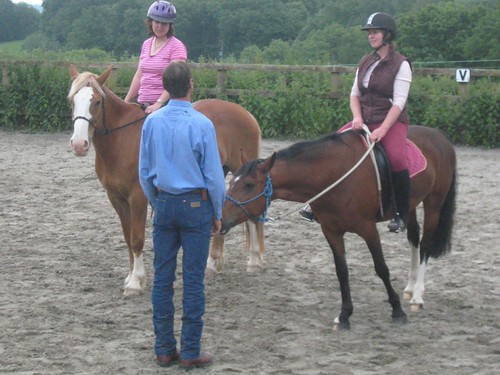
At the end of the session- quite a mellow group.
We started with markers set up in a wide zig-zag down the school and Steve had us moving around them, going from one side to the other in shoulder-in and then yeilding the hindquarters around the marker and heading for the next in shoulder-in on the othe rein. I don't think I'll be surprising anyone when I say I found this really difficult. The way Steve teaches it, Shoulder in is reasonably easy to get, but my timing between my hands and feet and Zorro's forefeet was just rubbish. It doesn't help that if Zorro sees something on the ground he really wants to go up to it and stomp it, so I was trying to get him on three tracks and he was trying to make a beeline for the block so he could kill it. With Steve's help and using a stick to block him a little we got things working a lot better, although I was finding we'd tend to have one good run and one bad one as I got my hands, reins, stick, legs and everything else in a tangle when we changed.

Shoulder-in, we has it- when Steve is there to help us.

Kerin and Lottie can do it pretty well.
The next exercise was to ride between the markers making a transition as exactly on the marker as possible. This was one Zorro and I found a lot easier, especially downward transitions which, for a horse with a whole lot more "whoa" than "go" are very easy indeed to get precise. You could see the more confident horses being very ready to slow down and the less confident ones keen to keep going over transitions. At one point Steve had us walking between the first two, cantering between the second and back afterwards. His reaction when I observed that was the second time I had cantered on a horse was very funny indeed. I felt the fact that it wasn't immediately clear from how I rode it was probably good news for my riding.
After that we worked in pairs, playing the mirroring game, where one person rides along the school however they want and their partner, riding parralel with them, has to follow their lead, making transitions at the same time and generally staying as close as possible. This is fun and it really takes your mind off what you are doing, which can really make things work more easily. After a bit of this we decided to try it with all four of us in the group taking it in turns to be leader and riding in two pairs, all cueing off the leader. We then tried it working as a line across the school, which worked particularly well when everyone just did a cantering charge up the length of the school. Everyone apart from us as Zorro was so excited about the notion of cantering he just jumped up and down on the spot, bless him. We ended up doing a spontaneous quadrille type pattern, riding four abreast but close together in a kind of figure-eight constructed from three circles. This is a really good exercise particularly for the riders on the outside as you need pretty good control of your horse's speed to be able to maintain position in the line if you're the mid point or the outside of a circle. Apparently Steve quite often has these moments where his students start thinking up their own activities towards the end of clinics. It was very entertaining and it felt like it looked pretty good as well...

The mirror game.

I think I'm following Camilla and Ferrum here.

A rollback type turn.

One side of the four-way mirror me and lunky black horse in front, Lyn and her elegant arab mare behind. Contrast.
We began the last day talking about timing and release, how what Steve aims for is to have a horse that is not moving away from pressure but one that is moving towards release. This is why the theme of rewarding the thought is so central to what we have been learning over this clinic. By really feeling for the horse before you ask for something you set things up so they can succeed but if they are heavy Steve aims to take the pressure up fast and strongly enough that he can give a clear and understandable release.
We also did some leading work among ourselves, working in threes with two people playing the horse and one playing the person leading them. This is a great exercise for learning about how subtle you can be and still get the message through and for feedback on your groundwork generally as it can be hard for your horse to explain exactly what they feel you are getting wrong. It certainly showed me a whole lot the first time I did it and a recurring theme every time I have seen this done, is that the human horse does the same things that the person leading's real horse does.
In the morning they were working to consolidate the work they had been doing over the week. Working with Small Steve did some really high-energy work, taking him really fast and then asking him to come back down. Small found going fast easy and slowing down quite hard but it served it's purpose, which was to show him that if he could survive that then he didn't need to get anxious working at walk or trot.

High energy work means high-energy pictures...

...Small has a lot of go...

...a lot of go.

With the pressure off.

"If this horse bit me I'd be really pleased!"

Steve had to make himself that small and far away before pony could lick and chew.

Jake has a pretty big brace going on in his neck and throughout his body here, Steve is helping him find the way out of it.

Small trotting calmly in the school. That is a big step for him.

Small pony with a big walk.
In the saddle they worked on the indirect-direct rein circles that we had been doing on the first day. Jake was still tending to stay straight if he could and Steve spent quite a while working on that. Seeing Jake and Polly's owners, both of whom wouldn't have dared ride without a bit at the start of the week, sitting with their relaxed horses in only a halter was really something and they had obviously taken some pretty big steps forward in themselves.

This isn't a great picture, but they are cantering. In the school. And Small didn't lose the plot. An even bigger step than the trotting above.
In the afternoon we did some work with ropes, starting by working to get the horses comfortable with longer ropes and higher energy and then once we were in the saddle throwing the rope over a post and then using it to make a properly round circle. Zorro was great at tolerating the rope but it turns out I am rubbish at throwing it. In my defence, a 22' soft horsemanship rope is a good deal harder to work with than a proper lariat, which is made of vastly stiffer rope, but even so the many many attempts I had to make do add up to a somewhat poor effort. Having roped our post I started to work on moving out onto the circle, at which point Zorro got a bit outside the circle so I ended up pulling the post over, which then chased us, which mean't we had to get away from it, which made it chase us...

Ferrum dealing with the lariat swinging around him.

Also something he can deal with in the saddle.

Circling around a cone they have roped.

Zorro doesn't mind me swinging a loop.

After a while it was alright in the saddle too.

Not so sure about a post on a rope.

ZOMG!!! It's chasing us!!!
Once we had got through that I managed to get things a bit more controlled an in the right distance from the post so we stayed on the rope. We were also doing turns so that either his quarters went under the rope or I had to flick it over his head as we went round, both of which he was really good with.

The circle, once we got it.
The next exercise was dragging, using the thing being dragged to help find a bit of impulsion and to change the horse's shape for shoulder-in and similar exercises.

At first Zorro mostly wanted to numble the rope.

Dragging the post so that Lottie ( black horse on the right ) could understand it wasn't going to kill her.

Zorro!!!!11!1!11one

Trotting in shoulder-in.

At the end of the clinic Steve helped Lyn and Namara do a bit of work without the bridle, something that Namara seems to be very comfortable with. It's a testament to their amazing relationship that Lyn could do this in walk, trot and canter with a horse as exceptionally flighty horse as Namara and stay with her and beautifully in control. They are always inspiring to watch but this was just fantastic.

What a tremendous team.
I was really happy that Zorro and I had got from running away from the post to this:

That was a big achievement for us too, no question.
Once again it was a tremendous weekend and we got a whole lot done. It was good to see Steve teaching the basics ( and be reminded that I could probably patch those up a little myself ) but also to see how over the last few years those of us who have persisted have come a really long way with our horses. There's always further to go- that's the whole point of this journey, but we've all made changes in ourselves for our horses that have helped to get us a little closer to the goal of riding our horses' minds.
To find out a bit more about Steve I recommend the Silversand website, you can also see him in action on youtube - some of that video is quite old but it's also a fitting tribute to Foxy, the Apaloosa he is riding for much of it, who was Steve's horse for almost as long as he's been doing this stuff and who he lost ( through complications on a minor operation ) just before they left Australia. Steve made the point a few times over the course that you really have to make the most of what you have while you have it.
x-posted with![[livejournal.com profile]](https://www.dreamwidth.org/img/external/lj-community.gif) horsemanship
horsemanship
the format was two half-day sessions each day, one for people starting out with Silversand the other for existing students wanting to take things further.
sleepsy_mouse and I both rode on this one and as it was longer sessions I took fewer notes, but I do seem to have a heck of a lot of pictures, so expect this one to come in quite lavishly illustrated.As usual we began each day with an introductory talk with Steve. Because Phillip Nye had been teaching with them a few months ago he had quite a lot of new ways of talking about the work we have been exploring. We talked about what everyone wanted to achieve from the clinic, which was included softness, refinement, trust, confidence and forward ( that last one was me ) and Steve introduced the model of the horse's emotional state with the inner circle of confidence, the surrounding circle of unsureness and everything beyond that being fear of death. The place where a horse learns is in the "unsure" zone. By working to expand the safe zone and stay inside the "unsure" zone you are giving the horse the best chance to become more confident and responsive to what you have to ask. Steve talked about how rather than working a horse through a problematic behaviour as he might once have done he now finds the boundary where it starts to become a problem and works to stay just inside that boundary tuning in to what the horse is feeling so that he never gets to the place where the horse can't handle it but just builds up the horse's confidence until it is alright. This is a simple principle but it needs you to be very consicous of what a horse looks and feels like when it is anxious and what changes it undergoes as it becomes more anxious. These can be very subtle indeed - a minimal speeding up of the feet, a bit of tension in the muzzle - but if you can be aware of them you can head off trouble before it arises.
Once a horse is outside the "unsure" zone and into "fear of death" you are dealing with pure instinct and at that point all you're going to be doing is firefighting until you can get the horse back. Some training approaches will push the horse into this emotional state in order to get it over a problem of some sort, flooding it in the hope of desensitising it, but this approach can be very unreliable and cause a lot of stress for questionable return. It's easier and more effective to work with the horse's rational mind.
Steve also talked about persistance and how if you're not getting the results you want then you need to change what you are doing. If you keep doing the same thing you will keep getting the same thing, but you need to be aware that when you change something, even something that seems insignificant to you, it can change everything for the horse.
The big question he wanted all of us to be thinking about the whole time is "what is my horse learning right now?" Every horse learns from when pressure is released and they are always learning from us.
The basic cornerstones of the Silversand approach are building Confidence, Yeilding and Accurate Patterns- these aren't a linear progression, more the corners of a triangle, each of which feeds in to the other two. Which lead on neatly the the morning session.
Thursday Morning
The morning began with work on Confidence, desensitising the horses to the tools we use around them and getting them able to handle undirected energy. This began by just swinging the stick and string gently without any focus on the horse and finding how much they could handle before they felt the need to move away. When they did move it was a simple case of keeping the movement going until they stopped so that they learned that running away from it didn't solve the problem.
A pony with the brilliant name of "Pog" learning to cope with Steve putting a lot of energy in front of him.
Stopped moving and having a bit of thinking time, all attention on Steve.
A few minutes more work and he can tolerate the string even when it swings around him.
Some horses were just getting stuck on circling, falling into a familliar pattern of lungeing and with them Steve was using the stick in front of them to stop them just using that as a way to avoid learning the lesson we were working on, which was that things can happen around them and they don't have to run.
The ultimate aim would be that you could get a long rope or a stick and string and be swinging it as fast as you can behind your horse at liberty without them leaving. That's not something any of us are likely to try but it's a good picture of where we could be taking this work.
The next exercise was a saddling exercise. As Steve tells it, Saddling and bridling are not about the activity of putting a saddle or bridle on the horse, it's about the horse's attitude to it. Surprisingly many horses will move away if you approach them with a saddle while they are untied.
They worked on this by throwing the tail of the lead rope across the horse's back so it landed and swung over and around them, working on the same principle that the horse shouldn't react to this at all. They built up from that to jumping up beside the horse, leaning across it, swinging legs and arms around and generally making a fuss. Rather than having to tiptoe around your horse it's much better to prepare them for the fact that sometimes you will make mistakes and equip them to handle it. This approach was very much setting things up to prepare the horse for saddling- if your horse can't handle your approach without a saddle why would they accept it with one.
Using the tail of the rope over the back of Vita.
From there they did some work towards mounting, some of the same stuff that Steve would do starting a new horse- bouncing up and down beside them, lying across them and swinging arms and legs around and so on. Rather than tiptoe around a horse, especially an anxious one, Steve works from the idea that the horse needs to get used to us making mistakes when we're mounting and just tolerate it.
I want to be able to jump onto a horse that tall ( I think she is 17.2 ) from the ground.
It's not the handler's responsibility to stop things happening when they are doing this work, just to handle them when they do in a calm and effective way so the horse can understand that things really are alright.
Having worked on the basics of confidence they moved on to Yielding. Until the horse is confident they will brace against you rather than yeilding when you ask them to and all you will do is teach them to brace more. It's interesting to see how, even in the most advanced horses there are a few braces that need working on- most people aren't really aware that this is something their horse is doing but once you have learned to see it you see it very frequently.
The first yielding exercise they worked on was head-lowering. This is a case of putting a gentle feel below the chin on the halter- as little as you can but enough that the horse is trying to find a way out of it and waiting for them to lower their head before releasing the pressure. Some horses get really stuck and need their head moving gently from side to side to free them up a little or try to move their feet, which is fine but doesn't release the pressure. Once the horse can lower their head you can ask them to soften at the poll by moving your hand in towards their chest and then create a slight backward lifting motion to get a soft backup. You want the head and neck to be soft and unbraced before you ask for backup so the horse doesn't learn to back up with braces.
Jake backs up.
Next up was a turn on the haunches- you work on this by asking with one hand on the side of the halter and the other on the shoulder. First you ask the horse to bend their neck away a little, then ask for this to be continued by stepping their outside foot away from you without stepping forward, pushing on you or moving their back feet. Once this is working you can start to get more of the circle by asking on the shoulder for the other forefoot to keep the circle. This happens in this order so that if the horse starts pushing forward, which is very common, you can use that backup to move them back away from you and set things up again afterwards. When Steve is working on this or teaching it he really makes the point that you need to stop the horse from being heavy from the first time you do this- controlling the shoulder will be a whole lot of your steering from the saddle and if you teach the horse to be light with it from the start you won't have any problems later. Steve said that the way he works now it's much easier to start a new horse than to work with one that someone else started in the past because they don't have the patterns of leaning and heaviness built into them. Steve's own horses are exceptionally sensitive and other people often have real problems riding them because they are so responsive that they require that their rider be very subtle.
Steve working on a turn on the haunches with Pog.
The final exercise of the morning was getting the horse to yield their hindquarters. This is done by asking them to bend their neck towards the handler and then step the hindquarter away without moving the shoulder. This is amazingly important for ridden work because being able to disengage the hindquarters and bend the horse to a stop is your emergency brake. A one-rein stop is the most effective way of stopping a horse but if they haven't learned to do it in a ridden situation you have a fairly good chance of the horse falling over if you try to apply it in an emergency. Obviously no-one wants that to happen so it's very important to get this bend happening right. One thing I found was that rather than putting pressure on the horse's head to ask for the turn, Steve was asking as softly as he would want the horse to respond and then using something else ( body language, movement, clicking his fingers and so on ) to back up his request. That way you avoid teaching the horse to be heavy.
Steve asks Jake to step away off a suggestion on the rope and clicking his fingers.
Thursday Afternoon
We tacked up in the rain and began the afternoon by warming up with basic groundwork and work on the circle. I needed to really focus on keeping Zorro's circles round, pushing his shoulder out when he started trying to cut corners ( or create corners, I guess, as it was supposed to be a circle ) and Steve observed that I was pulling on him. Steve's idea of pulling is putting any pressure on the lead rope at all- if you do this you will teach your horse to ignore it and it may be difficult to get it back if you want that kind of lightness in the saddle.
It was pretty wet.
As usual, Small had the opposite problem to Zorro- he was picking up speed the whole time, a sign that he is anxious about what is going on. It's easy to ignore a horse running away at the walk because they aren't really going anywhere, but if they can't stay with you at walk then you're likely to have the same problem and potentially worse at higher energy levels. The important thing for him was to take control and change things as soon as he started going onwards when he had been asked to stop.
When everyone felt their horses were ready we got on, by which point the soft suede seat of my saddle was absolutely soaked. Zorro was being very reluctant to move away from Small, thinking to buck and just turn back to his friend whenever I asked him to head off around the school. Steve had me allow Zorro to choose our direction, but take control of the speed so that if we were near Small we were going faster if we were further away he can go slower, a lot like hunt the thimble with speed. That way Zorro didn't get too far out of his comfort zone but his comfort zone got a whole lot less comfortable and after a few minutes he made the choice to go down to the other end of the arena.
We worked on a few different exercises, starting with circles from the indirect and direct rein, where you ride along the fence then use the indirect rein to ask the hindquarters towards the rail, which has the effect of moving the forequarters away from it then as the turn continues changing to a direct rein to go through the gap we had just created and circle back onto the rail. It's a lot less complicated than it sounds and very interesting to see how light Zorro was able to be with it.
We also did some balance work, asking the horse to go forward then take a set number of steps back ( one or three ) and continue forwards again, both in walk and trot. This is a good exercise for getting the horse stopping in balance, ready to move back or forward as asked.
I was really pleased with how Zorro was working by the end of the session, really responsive and giving me the feeling that we were working quite accurately. It wasn't until after we had finished that I realised just how heavily it had been raining all afternoon.
Friday Morning
The morning began with a bit more talk on theory, explaining some of the core concepts Phillip Nye had been teaching with them recently, including the concept of pathways. Horses form neural pathways as they learn in exactly the same way we do and Phillip had been taking this into a very literal analogy of paths that one might travel down- some are wide and regularly travelled, others thin and overgrown. We can think about what paths our horses have available to them now and how we can change that map. Thinking in those terms can help us to be emotionally neutral, which makes it easier to see the horse's mental state and to see what is there rather than what we think is there. One thing to work on is to dissociate emotion from the energy we use to control our horses ( I hate this term, because it makes it sound like we're using the Force or something when actually it's more a way of moving, but it is quite useful ) and from the horse's emotion - the last thing they need from us is to be getting emotional when they do- that's when they need us to be calm.
Steve talked about the training tree that a lot of traditional dressage is based on, which looks like this:
- Relaxation
- Regularity - Steadiness, rhythm, tempo.
- Freedom - Allowing the horse to move- it's easy to reduce this early on if you're a little nervous of what the horse might do, only to find later that you needed it.
- Contact - Creating a connection and acceptance of the rider's hands, seat and legs)
- On The Aids - Responsiveness. If you're pulling or leaning the horse is not on the aids. They need to be listening and responding to the lightest cues from the rider.
- Straightness - Which includes straightness on the circle and during lateral work.
- Balance - Which will create lightness and ease of movement.
- Durchlassinkeit - "There is no word in English for zis concept." What a weak argument. There are loads of words in English, many more than any other language. I bet there is one somewhere. Anyways it means "pliability, forwardgoing and suppleness."
- Swing
- Collection - Elevation, cadence and suspension
The stages of the training tree are the foundation that you need to have in any horse before you start specialising. We tend to work on the second four before maybe we have the first four really solid, but if you do that you will make things worse rather than better.
Balance was another theme of the morning's discussion because it's so important not just in physical terms but in terms of striking the right balance in our attitude and our horse's attitude. Steve wants a balance between confidence and fear in his horse- if you have a horse that is so confident it will walk all over you that is a dangerous situation, so is having a horse that is so afraid that they don't even know you are there. A horse that is more confident will tend to be slower, one that is more afraid will tend to be faster- this ties back in to the idea of horses running away in walk- if your horse is walking faster than you asked them to then they are running away. If the horse is saying "that path is not available" then rather than trying to push through and risk flooding them you need to find a way to make it tolerable. Rather than running down a path overgrown with brambles it may be easier to go along more slowly with secateurs to clear it as you go.
The morning group started by revisiting the exercises from Thursday to see how well horses and humans had managed to keep it all in mind. The confidence work was really important for people as well as horses- when you get anxious you fall into familiar patterns so unless those patterns are working out remarkably well for you it's well worth working on this. By setting up higher energy situations and helping your horse to learn to tolerate them you end up with a more steady-going horse and a better idea of how they are likely to react in a situation that they find nervous, which can in turn help you feel confident around them.
Helen, who was working with Vita, bareback. She did need a leg-up mind.
More work on preparing the horse for bareback riding.
On the turns most horses were at first resistant to being asked to flex, bracing against the rider's hand. Steve talked about reaching down the rein for the horse's mind, aiming to get their attention ahead of asking. He showed how a horse that is actually yeilding will turn their neck with their head in the same orientation rather than twisting the head. Even with the head turning if the horse has flat spots in the neck that is indicative of bracing - they are not giving with all their muscles.
They worked on getting the turns happening off a suggestion rather than a feel, so that they were asking using body language rather than physical pressure, being careful that if the horse chose to rush off rather than staying with the handler the way to handle this was not to block them but to just turn the hindquarters away and change direction so they have to come back to the halder.
In the saddle they continued the same work, starting with getting the horses comfortable with more movement around them from the saddle with their rider swinging the end of the lead rope around themselves. While doing this they kept the horse on a bend so that if the horse chose to go anywhere they would be circling and just waited for a good halt before releasing the pressure.
Having got halt really solid they moved on to bending the horse to a stop. This uses an indirect rein, bringing the horse's head round as the rein is lifted and brought inwards to pick up the outside hind foot. This is best done when the outside hind foot is leaving the ground as that timing gives the horse the best opportunity for lightness rather than having to wait until that foot is available to move or move something else.
Steve asks Pog to step away...
...creating a bit more energy with his hand...
...Pog steps out.
Friday Afternoon
Kerin, Lottie and Sgt Wilson watching Steve at work.
We started by working on getting with the horse on the ground, getting their feet connected with ours. With Zorro I was working on just making transitions from slow to fast movement, but others were more technical- Lyn and Namara were working on their flying lead changes at this point. The exercise entailed leading from beside the horse, approximately where one would be if one were riding and then work on getting forward, halt, and backwards through the horse mirroring our body language. I found that I was tending to not make it clear enough what I was about to do, slowing down too quickly and not giving enough warning before speeding up. To start with it's really important to keep your changes slow enough that your horse can follow them, making sure you telegraph what you will be doing next. You also need to keep your hips pointed where you are going- if you turn too far towards your horse they will turn towards you and you end up getting in a bit of a muddle.
Guess who kept the camera on him during this session...
In the saddle we worked on backing up, getting a really free and brisk backup, then taking things from a backup into a turn by simply dropping one rein. Steve helped us to back up by being really scary in front of Zorro, which ended up with us effectively running backwards. What made a big difference to Zorro being able to find consistent backup was just squeezing on the rein with his steps rather than asking with a steady pressure, that way he knows he is right each step and that if he keeps offering what I'm asking for he'll keep getting release for it.
Everyone watching what is going on.
Saturday Morning
Because we had a few people from the morning session who were only able to do the first two days of the course, we moved things around a little and
sleepsy_mouse and small joined the morning group because although sleepsy_mouse is quite capable of working with the more experienced group, Small pony really needs confidence and some of the more basic things just to help him feel braver in the school environment. The morning session started with a bit of talking about what you are teaching the horse at any given time- Steve suggested that maybe about 20% of horses are wired in such a way that most people can handle them- this was never a problem in the past because we were a society of horsepeople and being able to handle a horse was a core skill for many people. These days that is no longer the case and we need to work harder to catch up with the amount of skill our predescessors had out of necessity.
There was a bit of talk about leadership and what that involves. A leader expects the horse to try to do something when they are asked. It may be that what looks to the human like a straight path from A to B looks to the horse like a complex maze that they can't possibly find their way around and we need to be ready to understand that.
The other important theme was preparation and how important it is for our safety. Before we do anything with our horse we need them to be well prepared for what we are going to ask for. You simply cannot have a horse that will not stop or will not go if you are riding off the yard, especially if you're riding on the roads ( as most of us in the UK have to ) it is a real danger.
The morning session picked up where they left off on Friday with more bending to a stop from higher speeds and then asking the horse to stay calm while the handler had the rope swinging over their head, ready for one-rein riding.
Polly gets used to a rope over her head. I mostly included this picture because of her facial expression.
Small was not happy about the rope swinging over his ears.
Do. Not. Want.
A lot braver now, he's walking quite slowly while the rope is spinning overhead.
Then they worked more on a circle Small and Jake, a rather lovely chesnut gelding, both had real patterns of falling into the circle through their shoulder. Steve talked about what you want from a circle, which is for the outside of the horse to be stretched rather than the inside to be contracted. If a horse is pushing in he will ask the head to come in a little and the shoulder to be pushed out at the same time. By applying this absolutely consistently the horse will learn to stay out on the circle rather than dropping in.
During the morning Kerin brought in her young horse, Gold Dust for a bit of work. Aside from a few sessions during the recent Tom Widdicombe clinic and a little bit in the intervening weeks, Gold Dust hadn't really done any work at all. Talking with Steve Kerin realised that because of Gold Dust's charming nature and her youth she had been allowing the filly to get away with things she wouldn't expect from an older horse. Steve reiterated the point about working with the horse you want from the start. "Don't be afraid of getting effective," he said, "be afraid you might not get effective." After a few moments where Gold Dust experimented with what her relationship with Steve would be, she settled very fast working out what she was being asked for and how she could do it.
Gold Dust learns about Steve's personal space...
..and that she can't just run away from him.
Gold Dust is learning about who controls whose feet, Polly looks on.
She's pretty much got the idea at this point that if Steve says she should do something it's easiest to do it.
And relax...
Much calmer. She looks a bit RSPCA here, but she's just young, I assure you she is very well fed.
The first time anyone has been on her back at all.
Kerin hopping aboard again, from a more flattering angle.
It was a big deal for Polly's owner to be able to ride her without a bridle.
Jake is pretty settled with a swinging rope by this point.
More rope-work.
If you were ever wondering what a well fitted rope-halter might look like, this is it.
Steve helping
sleepsy_mouse get the feel of the rope...and explaining what he is looking for on the rein.
Small bless horse.
The riders were working on timing of their requests to match the horse's footfalls- if you don't get in time with the feet then if you are asking for something at a time when the horse can't make that movement you're effectively giving them no choice but to pull on you until that foot is free to move. With Jake he was still dropping his shoulder ( you almost always find the same patterns between riding and groundwork ) but he needed very subtle guidance to pick it up, just lifting is shoulder ut into balance as his inside foot came up, almost off finger strength. In this case pulling on the rein would have lost his movement very easily.
At the end of the session- quite a mellow group.
Saturday Afternoon
We started with markers set up in a wide zig-zag down the school and Steve had us moving around them, going from one side to the other in shoulder-in and then yeilding the hindquarters around the marker and heading for the next in shoulder-in on the othe rein. I don't think I'll be surprising anyone when I say I found this really difficult. The way Steve teaches it, Shoulder in is reasonably easy to get, but my timing between my hands and feet and Zorro's forefeet was just rubbish. It doesn't help that if Zorro sees something on the ground he really wants to go up to it and stomp it, so I was trying to get him on three tracks and he was trying to make a beeline for the block so he could kill it. With Steve's help and using a stick to block him a little we got things working a lot better, although I was finding we'd tend to have one good run and one bad one as I got my hands, reins, stick, legs and everything else in a tangle when we changed.
Shoulder-in, we has it- when Steve is there to help us.
Kerin and Lottie can do it pretty well.
The next exercise was to ride between the markers making a transition as exactly on the marker as possible. This was one Zorro and I found a lot easier, especially downward transitions which, for a horse with a whole lot more "whoa" than "go" are very easy indeed to get precise. You could see the more confident horses being very ready to slow down and the less confident ones keen to keep going over transitions. At one point Steve had us walking between the first two, cantering between the second and back afterwards. His reaction when I observed that was the second time I had cantered on a horse was very funny indeed. I felt the fact that it wasn't immediately clear from how I rode it was probably good news for my riding.
After that we worked in pairs, playing the mirroring game, where one person rides along the school however they want and their partner, riding parralel with them, has to follow their lead, making transitions at the same time and generally staying as close as possible. This is fun and it really takes your mind off what you are doing, which can really make things work more easily. After a bit of this we decided to try it with all four of us in the group taking it in turns to be leader and riding in two pairs, all cueing off the leader. We then tried it working as a line across the school, which worked particularly well when everyone just did a cantering charge up the length of the school. Everyone apart from us as Zorro was so excited about the notion of cantering he just jumped up and down on the spot, bless him. We ended up doing a spontaneous quadrille type pattern, riding four abreast but close together in a kind of figure-eight constructed from three circles. This is a really good exercise particularly for the riders on the outside as you need pretty good control of your horse's speed to be able to maintain position in the line if you're the mid point or the outside of a circle. Apparently Steve quite often has these moments where his students start thinking up their own activities towards the end of clinics. It was very entertaining and it felt like it looked pretty good as well...
The mirror game.
I think I'm following Camilla and Ferrum here.
A rollback type turn.
One side of the four-way mirror me and lunky black horse in front, Lyn and her elegant arab mare behind. Contrast.
Sunday Morning
We began the last day talking about timing and release, how what Steve aims for is to have a horse that is not moving away from pressure but one that is moving towards release. This is why the theme of rewarding the thought is so central to what we have been learning over this clinic. By really feeling for the horse before you ask for something you set things up so they can succeed but if they are heavy Steve aims to take the pressure up fast and strongly enough that he can give a clear and understandable release.
We also did some leading work among ourselves, working in threes with two people playing the horse and one playing the person leading them. This is a great exercise for learning about how subtle you can be and still get the message through and for feedback on your groundwork generally as it can be hard for your horse to explain exactly what they feel you are getting wrong. It certainly showed me a whole lot the first time I did it and a recurring theme every time I have seen this done, is that the human horse does the same things that the person leading's real horse does.
In the morning they were working to consolidate the work they had been doing over the week. Working with Small Steve did some really high-energy work, taking him really fast and then asking him to come back down. Small found going fast easy and slowing down quite hard but it served it's purpose, which was to show him that if he could survive that then he didn't need to get anxious working at walk or trot.
High energy work means high-energy pictures...
...Small has a lot of go...
...a lot of go.
With the pressure off.
"If this horse bit me I'd be really pleased!"
Steve had to make himself that small and far away before pony could lick and chew.
Jake has a pretty big brace going on in his neck and throughout his body here, Steve is helping him find the way out of it.
Small trotting calmly in the school. That is a big step for him.
Small pony with a big walk.
In the saddle they worked on the indirect-direct rein circles that we had been doing on the first day. Jake was still tending to stay straight if he could and Steve spent quite a while working on that. Seeing Jake and Polly's owners, both of whom wouldn't have dared ride without a bit at the start of the week, sitting with their relaxed horses in only a halter was really something and they had obviously taken some pretty big steps forward in themselves.
This isn't a great picture, but they are cantering. In the school. And Small didn't lose the plot. An even bigger step than the trotting above.
Sunday Afternoon
In the afternoon we did some work with ropes, starting by working to get the horses comfortable with longer ropes and higher energy and then once we were in the saddle throwing the rope over a post and then using it to make a properly round circle. Zorro was great at tolerating the rope but it turns out I am rubbish at throwing it. In my defence, a 22' soft horsemanship rope is a good deal harder to work with than a proper lariat, which is made of vastly stiffer rope, but even so the many many attempts I had to make do add up to a somewhat poor effort. Having roped our post I started to work on moving out onto the circle, at which point Zorro got a bit outside the circle so I ended up pulling the post over, which then chased us, which mean't we had to get away from it, which made it chase us...
Ferrum dealing with the lariat swinging around him.
Also something he can deal with in the saddle.
Circling around a cone they have roped.
Zorro doesn't mind me swinging a loop.
After a while it was alright in the saddle too.
Not so sure about a post on a rope.
ZOMG!!! It's chasing us!!!
Once we had got through that I managed to get things a bit more controlled an in the right distance from the post so we stayed on the rope. We were also doing turns so that either his quarters went under the rope or I had to flick it over his head as we went round, both of which he was really good with.
The circle, once we got it.
The next exercise was dragging, using the thing being dragged to help find a bit of impulsion and to change the horse's shape for shoulder-in and similar exercises.
At first Zorro mostly wanted to numble the rope.
Dragging the post so that Lottie ( black horse on the right ) could understand it wasn't going to kill her.
Zorro!!!!11!1!11one
Trotting in shoulder-in.
At the end of the clinic Steve helped Lyn and Namara do a bit of work without the bridle, something that Namara seems to be very comfortable with. It's a testament to their amazing relationship that Lyn could do this in walk, trot and canter with a horse as exceptionally flighty horse as Namara and stay with her and beautifully in control. They are always inspiring to watch but this was just fantastic.
What a tremendous team.
I was really happy that Zorro and I had got from running away from the post to this:
That was a big achievement for us too, no question.
Once again it was a tremendous weekend and we got a whole lot done. It was good to see Steve teaching the basics ( and be reminded that I could probably patch those up a little myself ) but also to see how over the last few years those of us who have persisted have come a really long way with our horses. There's always further to go- that's the whole point of this journey, but we've all made changes in ourselves for our horses that have helped to get us a little closer to the goal of riding our horses' minds.
To find out a bit more about Steve I recommend the Silversand website, you can also see him in action on youtube - some of that video is quite old but it's also a fitting tribute to Foxy, the Apaloosa he is riding for much of it, who was Steve's horse for almost as long as he's been doing this stuff and who he lost ( through complications on a minor operation ) just before they left Australia. Steve made the point a few times over the course that you really have to make the most of what you have while you have it.
x-posted with
horsemanship